
Author: Pete Fry
-
Opinion: Breaking down the breakdown of integrity at Vancouver City Hall and what might come next
Pete Fry: The integrity commissioner found that material decisions were being made by the ABC caucus to move council business while bypassing public oversight.
An investigation by Vancouver’s integrity commissioner has found that Mayor Ken Sim and his ABC party violated the rules of local government — apparently without consequence. Now, ABC is suggesting that taxpayers could foot the bill for the legal costs they incurred while resisting the year-long investigation.
In late August, the integrity commissioner ruled that Sim and ABC breached the code of conduct and contravened the Vancouver Charter. Much has been said since, but I want to break down the breakdown in democratic process from my perspective as an elected councillor.
Over a year ago, I filed a complaint with the integrity commissioner, as I was concerned that ABC’s council majority was making decisions privately and enforcing whipped votes, both contrary to the laws governing Vancouver.
The integrity commissioner is an independent office appointed to uphold ethical standards among elected officials in the City of Vancouver. Led by a seasoned lawyer and legal team with decades of experience, the office found that material decisions were being made by the ABC caucus, as a council majority, to move council business while bypassing public oversight.
In practical terms, that allowed ABC to push through particular agenda items like eliminating the climate justice charter and putting millions of dollars of capital funding into their preferred projects.
ABC and their supporters, in their defence, have suggested they did nothing wrong, arguing that federal and provincial politicians meet privately to make decisions as party caucuses all the time. That is a fundamentally wrong interpretation of the law however, kind of like saying an offence committed in Canada is OK because it’s legal in the U.S.
Federal and provincial legislators are obliged under rules set out in the Constitution, but Vancouver, like all local governments in Canada, doesn’t exist under the Constitution; our municipal governments exist by provincial legislation. The province of B.C. has enacted the legislation that allows local governments to exist, collect taxes, make bylaws, land-use decisions and so forth.
In Vancouver, that legislation is called the Vancouver Charter and it specifies, among other things, that decision-making meetings of council must be open to the public. Open meetings have been a statutory requirement in B.C. for more than 140 years. This oversight and transparency is designed to keep local governments accountable to the people who elect them.
Multiple legal and judicial experts have concurred with the integrity commissioner’s position on open meetings within the construct of local government law. Earlier this year, the provincial ombudsperson called ABC’s defiance “a disturbing repudiation of the rule of law.”
The response from Sim and his ABC caucus has been defiant — they maintain the rules of law don’t apply to them. Sim has dismissed the complaint as a technicality or playing politics, and their office has insinuated through communications with Postmedia News’s Dan Fumano and others that my code of conduct complaint has cost the taxpayers a significant amount of money.
But the commissioner’s report makes clear that it was ABC’s legal teams that prolonged the process, likely racking up significant costs. Ironically, the bill for resisting an ethics investigation may now fall to the public. A disappointing end to what could have been a teachable moment — especially since the report offered no sanctions, just sound advice on good governance.
Published in the Vancouver Sun, September 3, 2025
-
Vancouver’s slow journey to slow speeds for side streets.
UPDATE – The motion passed unanimously!
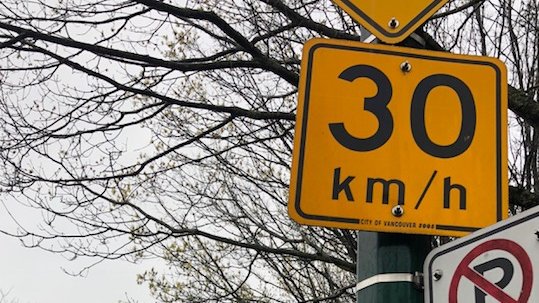
Tomorrow, the City of Vancouver appears set to approve new by-laws for 30km/h limit on local residential streets. Nearly six years since this — one of my first motions — passed at City Council and UBCM; again unanimously when I brought it back in 2024; building on work of local/global Vision Zero active transportation advocates.
If this motion passes (and I believe it will) it will mean that all residential streets (without a centre line) across Vancouver will be slowed to impact-survivable speeds. The challenge will remain around signage as it related to enforcement . While the by-law changes speeds city-wide, enforcement and likelihood of charges will be predicated by zones and streets that are clearly marked. Nevertheless the law as it is written means residential side streets city-wide are slowed.
The timing wasn’t serendipitous –after years of fighting for this change, sadly the recent tragic events of April 26 have underscored the fragility of human bodies relative to thousands of pounds of fast moving steel and rubber. May their memories be a blessing .
Here’s what I wrote back in April 2019
Safer slower streets: 30kmph residential street pilotOn a personal side note, I became involved in local community advocacy and ultimately civic politics after my close friend and good neighbour Paul Tynes was hit by a speeding minivan while he was walking across Prior Street. He suffered a traumatic brain injury and months in hospital and the neurological trauma ward. The long term impacts of those injuries ultimately claimed his life.
The idea of slowing speed limits down could be elaborated upon in a more detailed blog post but there’s lots of evidence to support the why, and articulated in #VisionZero work being done around the world. The gist of the ask, take the 80% or so of residential roads in the City (defined by lack of a centre line), lower the speed from the default 50km/h to 30km/h for improved livability, more comfortable public realm and drastically improved survivability in the event a pedestrian is struck by a car.
#VisionZero residential speed limit improvements have been implemented in Seattle, Portland, and in cites across North America and Europe.
Building on work done by the previous Vancouver council and advocacy by local governments across the province at Union of BC Municipalities, this motion tackled one of the roadblocks (no pun intended) the province threw at this work by way of the Motor Vehicle act – which effectively mandates to change the speed limits the city would need to post signage on every block of every street. This motion flips the ask that the province amend the MVA to allow us to set our own city-wide default speed limit (and conversely post higher speed limits on select arterials as necessary). The motion also makes provision for local pilot areas.
UPDATE This motion passed handily at Council and went on to pass after vigorous debate at UBCM. To date, the province has not given local governments the ability to set default speed limits.
WHEREAS
1. Currently, the BC Motor Vehicle Act stipulates a speed limit of 50 kilometers per hour within city limits.
2. The probability of pedestrian survivability is about 90% if struck by a motor vehicle travelling at 30km per hour, survivability is reduced to 20% if struck by a vehicle at 50 km per hour.
3. Today, Vancouver has 30kmph limit on designated bike routes, in school and playground zones and along a portion of Hastings Street, however a blanket speed limit reduction would require changes to the MVA, or significant signage and roadwork by the city.
4. Lower speed limits are more compatible with active transportation, and creating safer, better engaged, and more inclusive communities.
5. In 2012, The City of Vancouver’s Pedestrian Safety Study identified that mixed mode roadways, allowing for shared use of space by motor vehicles, pedestrians, and bicyclists without lane assignment (for example Granville Island) serves to reduce speed limits, while improving public realm, social connectivity, and increasing active transportation.
6. In 2016, The City of Vancouver endorsed Vision Zero, an international framework and project that prioritizes road traffic safety over speed or convenience and emphasizes that the responsibility for safety is shared by transportation system designers and road users.
7. In 2018, as part of their position paper, Modernizing the BC Motor Vehicle Act the British Columbia-based Road Safety Law Reform Group recommended: “A default provincial speed limit of 30 km/h for local (no centre line) streets should be included in the MVA, with municipalities enable to increase speed limits on local streets in a case by case basis by bylaws and posted signage.”
8. In 2018, the provincial government’s B.C. Community Road Safety Toolkit recommended lower speed limits in downtown areas and residential roads.
THEREFORE BE IT RESOLVED
THAT Council re-affirm the City’s commitment to Vision Zero, and a street system with no fatalities or serious injuries involving road traffic.
THAT Council direct staff to develop a pilot 30kmph speed limit demonstration project, focused on mixed mode use, reduced speeds, and complimentary road design with a mechanism to record and analyze before and after data.
THAT Council direct staff to identify a local street, area, or areas within the city to pilot a 30kmph speed limit demonstration project and report back with implementation strategy, timing, and budget as well as proposed road design changes by Q3 2019.
THAT Council submit the following resolution along with above preamble (articles 1, 2, 4, 7, 8) for consideration at the LMLGA and presentation at UBCM: “Therefore be it resolved that the UBCM lobby the province to change the Motor Vehicle Act to a default speed limit of 30kmh for local streets with municipalities enabled to increase speed limits on local streets in a case by case basis by bylaws and posted signage.”