
Tag: Archive

  • Why a forty-storey view-corridor-penetrating rental tower makes perfect sense for peak capitalism Vancouver.

    Why a forty-storey view-corridor-penetrating rental tower makes perfect sense for peak capitalism Vancouver.

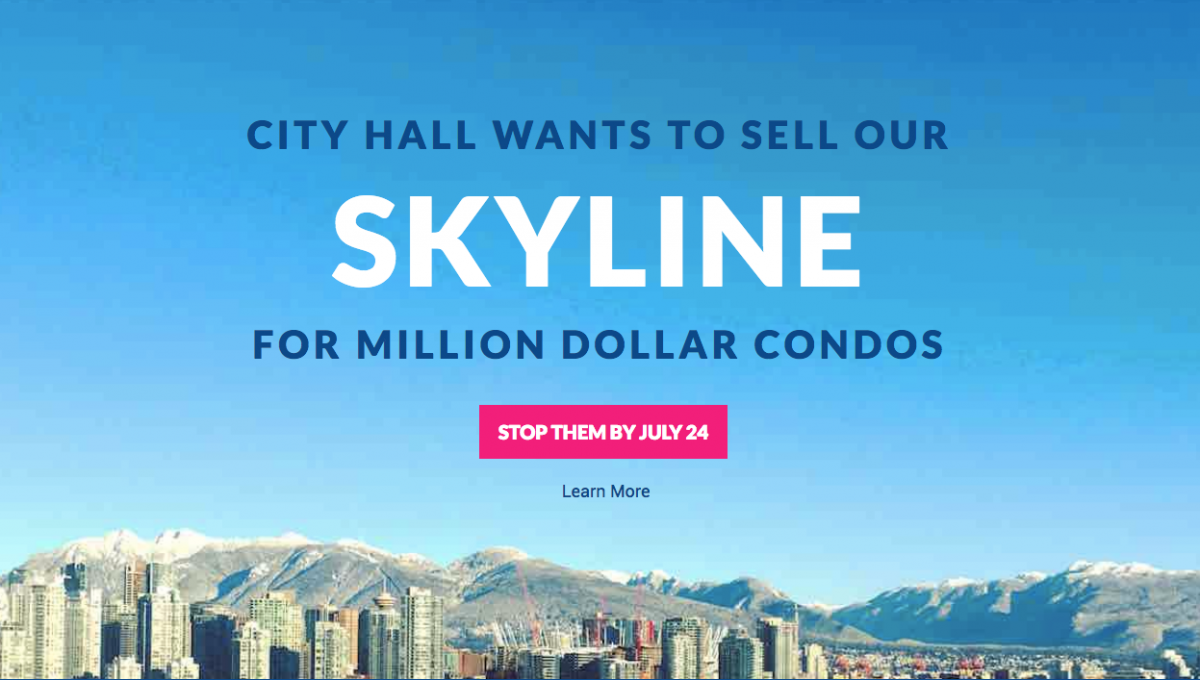
    Vancouver political watchers were on the edge of their seats as the first of three towers proposed to slice into the Vancouver skyline’s long-protected view of the mountains met with a council decision Tuesday July 22.

    The timing of this approval is convenient, developers of the site, Crown corporation PavCo have now cleared the way and set a precedent for two more proposed view-busting towers by Concord Pacific. Had they applied first, the fact Concord have been top donors to Vision Vancouver for the last decade would have raised uncomfortable questions of the outgoing council about who we were sacrificing our view corridor for.

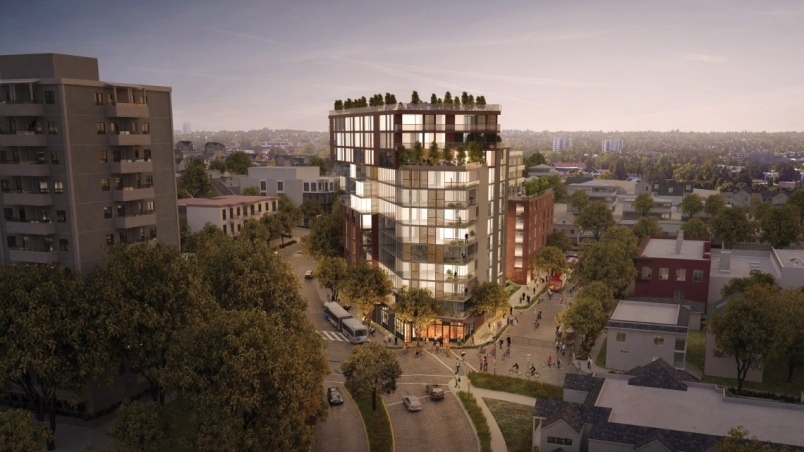
    As expected by some, the Vision majority on council voted to approve the 400’ tower proposed by PavCo for 777 Pacific. But in a surprise twist, the skyscraper would only be approved if the units weren’t condos — rather, market rate rental units.

    The view cones being sacrificed herald from the birth of Vancouverism, when we transformed lumber mills into Expo into glittering point and pedestal towers framed against our mountain backdrop. Breathless hyperbole about “world class city” have always really been defined by our context to our natural setting, not our architecture.

    The mountain views aren’t just iconic, they are our identity — planners, architects, legions of local residents and visitors have all shared the importance of preserving that view. A protected view blemished by what our outgoing mayor dismissed as a microscopic impact on par with traffic lights. A precedent by which future towers will proposed and judged.

    It’s easy (cynical) to paint a false dichotomy: It’s just a view after all. The mountains will still be there even when obscured behind condo towers or traffic lights; meanwhile there’s more important issues like housing crisis, opioid crisis, economic growth.

    But incursion into our view corridor illustrates the depth of an ongoing assault on the public commons: the cultural and natural resources accessible to all members of a society, the commons are resources belonging to the people not owned privately.

    Selling off our commons to private interests for meagre returns of dubious public benefit is how our governments approve affordable housing disconnected from local incomes, or drunk with casino cash ignore dufflebags of fentanyl poisoning our streets.

    In this case, is selling off the commons in exchange for market rental a public benefit?

    PavCo, the developers of the site, demurred to work out the math before commiting to the 400’ rental tower scheme (they retain an option for 300’ condos), but market economics for rentals in Vancouver suggest its likely a done deal.

    Luxury and premium purpose built rentals are a hot market for developers right now, driven by house-rich downsizers, new taxes on foreign ownership, and our low vacancy rate. These newly approved apartments, downtown and steps from the stadium and skytrain with their unobstructed (once-public) views of the north shore mountains will surely meet the luxury/premium criteria.

    One of the top developers for new rental property in the region is Wesgroup, currently promoting their massive market rental project in the new River District in Southeast Vancouver. Wesgroup also produce the cheekily-named RED Talks (Real Estate Development, get it?) where among other things they offer seminars on “crafting the narrative” and have featured keynote speaker Sonja Trauss, a San Francisco libertarian and market supply advocate.

    Despite the apparent market viability of purpose built rental, Wesgroup’s CEO recently mused that developers should be be exempted from paying community amenity contributions. The main challenge for developers building rental is speed of profit; rental is a long game whereas condos are relatively fast money.

    Yet certain existing city policies already waive a number of development fees (DCLs and CACs) for building rental housing.The bigger hinderance is often cited as city bureaucracy: extraordinary application and approval time, needless red tape and inflexible but apt-to-change regulations and codes.

    Just weeks ago the Straight reported a new benchmark for city-subsidized “affordable” rentals, $1730 for a one-bedroom apartment. The standard benchmark for affordability is 1/3 of income, our city’s median household income just shy of $73,000. City-defined affordability is about $300 a month shy of what the average 1 bedroom Vancouver household can afford.

    The city subsidy in the above affordable rental example comes in the form of a Development Cost Levy (DCL) waiver. DCLs are an important revenue stream that pays for infrastructure like sewers and roads, as well as parks, childcare and non-profit housing. While CACs are only applied on discretionary re-zonings, DCLs are levied per-buildable square foot and “imposed on every person entitled to the delivery of a building permit.” From building a 40 storey tower to renovating a single family home basement, any and all developments are expected to pay their share.

    Our social contract includes a right to the city and an obligation to support it. When we bargain away the collective public benefits —be it mountain views or payments into our shared infrastructure costs— it should be in the public interest and prefaced by real transparency with performance and profit reviews.

    Without a doubt, more purpose built rental in the City of Vancouver is in the public interest, but the degree to which we subsidize this must be commensurate.The public purse can’t be used to pad developer profits. Without transparency, there is no accountability.

    Some advocates of building more supply (the self-styled YIMBYs) quietly applauded yesterday’s view-scarring development for it’s supposed trickle down increase to rental stock, but this theory of supply-side filtering is unproven, some studies even found it does more harm.

    Given the last decade of development in Vancouver it’s hard to argue market housing untethered from local incomes has been helpful. Even

    But it seems we have had the tools all along, as a recent blog post by former City Councillor Tim Louis explained: in addition to approving or denying development applications and land use, under section 565.2 of the Vancouver Charter, City Council have the ability to enter into housing agreements with developers that stipulate (actually affordable) rents and rate of change.

    It’s time to start a fulsome and honest conversation about if and what we are trading public benefits for.

  • Why the views matter

    Why the views matter

    With the first of three mountain-view-penetrating proposed towers heading to Council for vote tomorrow, there’s a lot of talk both for and against the context and importance of Vancouver’s view cones. #SaveOurSkylineYVR

    It’s easy (cynical) to paint false dichotomy: It’s just a view after all. The mountains will still be there even when obscured behind condo towers; meanwhile there’s more important issues like housing crisis, opioid crisis, economic growth, right? 

    But the choice is a logical fallacy. 

    Incursion into our view cones represent the depth of an ongoing assault on the public commons: “the cultural and natural resources accessible to all members of a society” the commons are resources belonging to the people not owned privately. 

    Selling off our commons to private interests for meagre returns of dubious public benefit is how our governments approve affordable housing disconnected from local incomes, or drunk with casino cash ignore dufflebags of fentanyl poisoning our streets

    The purported public benefit (stadium upgrades) associated with this particular tower at 777 Pacific are arguably more a benefit to land speculators than the commons. In fact, increasing scrutiny of big city/big stadium projects raises questions about economic impacts, let alone public benefits of these types of projects.

    The only public free show at BC Place I recall: as a kid, watching the stadium inflate from the Connaught Street Bridge. In years that followed, Expo 86, and on subsequent sale of site for redevelopment, a commitment to preserve a view for the commons, not the highest bidder. That was barely 30y ago. 

    Those commitments we compromise today: be it laundering blood money, letting the market determine housing affordability, or selling off our views, only continue to set one awful precedent after another — where seemingly almost anything (and everything) is for sale.

    From the depressingly prescient and present Harper’s Magazine article from this month by Kevin Baker, The Death of a Once Great City“The question haunting our urban success stories today is whether the prevailing conservative addiction to privately owned, government-subsidized mega-development is sustainable.” 

  • Integrity of office and public trust.

    Integrity of office and public trust.

    Integrity of office and public trust.
    Yesterday morning I tweeted news that the City’s top properties guy: Bill Aujla, manager of Real Estate and Facilities had tendered his resignation to go and work for the Aquilini Group as VP of Real Estate.

    The news has garnered a lot of comment, mostly outrage and support for stronger lobbyist rules; but also defensiveness from the libertarian build-more-supply set who’ve suggested that ‘rules’ would put a chill on hiring top talent mangers at the City.

    Firstly, I want to be clear: I’ve met with Bill Aujla on a few different projects and found him to very helpful and smart. I also found him to have a good social justice lens. I’m not questioning his character or ability.

    My concern is the wild west of lobbying and political influence, and that there aren’t strong enough rules to that effect.

    I don’t think its unreasonable for city staff to seek employment in the private sector after their tenure, but in the case of top managers, especially where they deal with highly sensitive and valuable information we need some rules.

    The idea of rules isn’t especially draconian or out of the ordinary. In the corporate world, non-disclosure arrangements, non-competition clauses, and “cooling off periods” are all par the course. Other governments have regulations in place to address “revolving door politics.” in France, public officials who move between the public and private sectors are mandated a three-year wait between working in the government and taking a job in the private sector. [https://en.wikipedia.org/wiki/Revolving_door_(politics)]

    Noteworthy that in Mr. Aujla’s case, many of his meetings would have been “in camera” because if that information was made public, it would easily evoke a run on speculation and price gouging.

    Big money influence, loose lobby rules, conflict of interest: it’s the perception and well-warranted concern of these issues that has eroded public trust in city government.

    These concerns are consistent with our Vancouver Green ethics: we voluntarily rejected developer and big money contributions and have been leading the charge for better whistleblower protection and conflict-of-interest rules.

    PS. That Aquilini’s have city’s top real estate guy, former VPD chief, and at least two mayor candidates in their fold should be an obvious cause for concern.

  • No Tower on the Drive? More fallout on the BOFFO-Kettle deal

    No Tower on the Drive? More fallout on the BOFFO-Kettle deal

    Fallout over the BOFFO-Kettle deal that would have seen a new drop-in and supportive housing along with close to 200 market condos built atop an assembled parcel of private and public owned land and Commercial and Venables.

    As I commented to the Sun reporter yesterday and on Twitter as the story broke – it’s impossible to have an informed opinion on this issue because there is absolutely no transparency. Indeed, as close to half the property in question here is owned by the taxpayers, there should be an onus for even MORE clarity when it comes to negotiating Community Amenity Contributions. There isn’t.

    CACs are negotiated ad hoc, on a case-by-case basis between staff and developers. There is no public scrutiny, nor is there any predictability – this builds an air of frustration and distrust for both developers and the public. Where millions of dollars of public benefits are at stake, and where over the course of ten years of unfettered majority rule, Vision Vancouver have net millions of dollars in developer donations (just as the NPA did before them) it’s high time we took a closer look at how these benefits are calculated and for whom.

    In the case of the BOFFO-Kettle project, a conflux of issues: neighbourhood opposition to the height, scale and context of the project, with the developer on one side claiming the city has demanded too much public benefit to make the project viable, on the other side the city claiming the developer hasn’t even submitted an application and their asks are quite reasonable.

    Was the city being reasonable? Did BOFFO bail because of neighbourhood resistance, sunk costs, a softening speculative and offshore condo market, greener pastures and smoother sailing next door in Burnaby? — of course, we the public will never know what is really going on because the details of the CAC ask aren’t public.

    Mayoral candidate and UBC urban planning prof Patrick Condon once called CACs and spot zoning the soft spot for corruption. He’s right: let’s open it up and have honest good faith negotiations, we have a (moral) right to know what we are trading in public benefits for private profits.

    Postscript:  Interview and story here: http://vancouversun.com/news/local-news/scrutiny-over-how-development-fe…

  • On transparency and the Kettle Boffo deal.

    On transparency and the Kettle Boffo deal.

    Some years ago I met w/ Daniel Boffo, over n’hood resistance to height/density and perception that inclusion of city land in project called to question net public benefits, notwithstanding Kettle contributions.

    I suggested that the best solution might be to open the books, show people the pro formas ie. the numbers that make the project work vis a vis public land and public benefits involved.

    He was incredulous (paraphrase) “Why would I let people see my profits?”

    And therein lies problem.
    Transparency must factor in negotiated public benefits. Community Amenity Contributions (CACs) are negotiated in secret between developers and city staff (though some allege political/campaign finance influence too).
    We need to reform CAC process.

    Meanwhile:
    Boffo/Kettle claims CAC ask is too high. City claims there’s a $12m grant on the table yet a rezoning application hasn’t even been filed. In absence of transparency one can only guess real story:
    CACs? Spec-tax softened condo market? Sunk costs? Political change?

    Postscript: Originally published on Twitter