Tag: community safety

  • Over six months later, negligent developers still screwing over local neighbours.

    Over six months later, negligent developers still screwing over local neighbours.

    Word that the developers of the Brixton Flats project in Chinatown are refusing to fairly compensate residents of the half dozen homes they destroyed back in in April, when a wind storm collapsed a brick retaining wall they had been constructing (ironically covering over the very mural they have featured in their promo for the new development).

    I know at least one of the tenants is getting some pro-bono legal support. Not sure if Lee Benevolent Association are also getting stiffed by the Vancouver-Victoria Development Corporation GMC Projects. Apparently GMC have taken the slippery route and have lawyered up to avoid paying out.

    GMC should not receive occupancy permits for their new development until fair compensation and damages have been paid to the displaced neighbours — this situation is entirely unacceptable.

    Link to original story from April 8:
    http://www.cbc.ca/news/canada/british-columbia/6-people-displaced-after-…

    Link to developers:
    http://www.gmcprojects.com/brixton-flats/

    Postscript: 

    Follow-up #1 on local residents still displaced by a “luxury flats” development, when a wall collapsed and rendered the two neighbouring properties uninhabitable. The city has since followed up, but no word on how they will force these developers to take accountability or prevent this sort of thing from happening in the future.

    Thanks to the Sun’s Dan Fumano for digging in and daylighting this!
    http://vancouversun.com/news/local-news/dan-fumano-developer-fights-comp…

    Follow-up #2 Happy follow up to share!
    Lesley – displaced by neighbouring construction negligence has housing secured in new Community Land Trust Housing. It’s a small victory in the battle for local housing and there’s still follow up work to do and ensure the city holds the negligent builders accountable before issuing an occupancy permit. But today, YAY!

    http://vancouversun.com/news/local-news/dan-fumano-for-pensioner-whose-h…

  • From Grenfell to Balmoral: The case for public housing

    From Grenfell to Balmoral: The case for public housing

    Twitter: @PtFryFacebookGoogle+LinkedInEmail Me

    From Grenfell to Balmoral: The case for public housing

    June 14, 2017

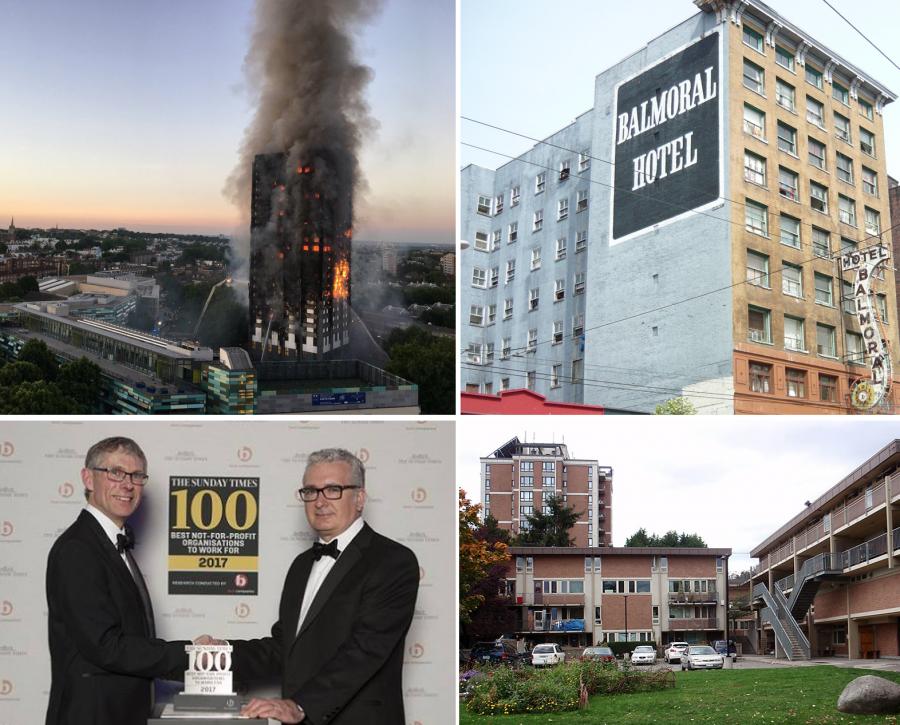
    As I post this, authorities are still determining the loss of life from the smouldering remnants of the 24-story Grenfell Tower in West London. Videos and images of the early morning towering inferno leave little doubt that the final tally of casualties and loss of life will be grim. Gut-wrenching stories of trapped residents, parents desperately trying to save their babies by dropping them from upper floors to rescuers below. This, the stuff of absolute nightmares.

    It’s too soon to guess the cause of the fire at Grenfell, but what we do know is that the residents of the building had been complaining for years about the appalling state of disrepair and dereliction of duty toward safety. Ultimately though, the cause of this tragedy is privatization of public housing.

    In November 2016, the residents’ led Grenfell Action Group wrote of dangerous living conditions and neglect of health and safety, warning ”that only a catastrophic event will expose the ineptitude and incompetence of our landlord, the KCTMO”. These resident complaints go back years, with another post from 2013 describing alarming evidence of serious negligence over several years part of a history of negligence that in all likelihood stretches back to 2004 and beyond.”

    In the UK, Tenant Management Organizations (in this case the Kensington Chelsea TMO, an “arms-length” organization) are non-profit non-governmental groups tasked with managing public housing stock. These public private partnership arrangements are effectively managed like corporations and criticized as a neoliberal scheme to privatize public housing. In the case of Grenfell, tenants described KCTMO as an ”evil, unprincipled, mini-mafia” who routinely cut corners on safety in order to save money.

    The trend towards privatization of public housing should sound familiar — these kind of neoliberal housing schemes are happening throughout the industrialized world. Here in Vancouver in 2014 we saw the privatization of two significant BC Housing projects: the Nicholson Towers (West End) and Stamps Place (Strathcona) under what’s referred to as the “Asset Transfer Program”. These substantially large tax-payer built housing projects are now owned by not-for profit organizations, underwritten by the province, and purchased at bargain prices. Rents are paid to the new owners with subsidies and social services, and those revenues help underwrite the non-profits’ operations. The scheme conveniently avoids any rent controls though, and being dependent on subsidies these units can eventually shift from social housing to (more expensive) affordable market housing, at the whim of government austerity measures.

    In a similar vein, we have SROs like the Balmoral. Privately owned and managed, rent on these SROs are also paid by provincially-funded subsidies and social services. In many cases, land owners’ profit comes at the expense of safety, cleanliness, livability and basic amenities (like elevators, garbage-free stairwells, and functioning bathrooms). As we have seen from the recent Balmoral debacle (which captured Vancouverites attention when it was evacuated, at the point of collapse after years of neglect) for over a decade the city turned a blind eye to legally mandated Standards of Maintenance. The city sanctioned SRO (single room occupant) designation allows for small size units without bathroom or kitchen. SRO designation is not tied to any specific amount of rent, so if the $375 per month social assistance housing allowance is no longer profitable, the buildings are sold and renovated into budget “micro-lofts”.

    The Grenfell fire is a tragic reminder that in too many cases of badly neglected low income and public housing —it’s not a matter of if, but of when— the building will become a risk to life and security of person. As groups like DTES SRO Collaborative have been warning, the Balmoral is not especially unique among the coterie of privately-owned, decrepit and unsafe SRO buildings. The policy-driven drift toward further privatization of public housing in BC should be cause for concern.

    With some notable exceptions (like Vienna, Austria) the industrialized world’s trend toward privatization of public housing has been been steady increasing since the 1990’s. Public Housing is being sold off. The foundational idea that housing is a fundamental human right and a responsibility of the state has been supplanted by the the need to cream profits for insatiable corporate greed —the essence of neoliberalism.

    This tragedy is not just happening 7500 kilometers away, the seeds of this kind of public housing dereliction are planted and growing here too. We see it in the legions of homeless on our streets, or the appalling photos of structural neglect in the Balmoral. As the horrific reality of the Grenfell fire unfolds and grief turns to outrage, let it spur us to action. Write your MLA and MP.

    Call upon the new BCNDP-Green supported government to make good on their promise and expedite the building of new social housing.


    Call on federal government to make building public housing part of their new Poverty Reduction plan.


    Call on city government to unlock land potential for new housing and to strengthen inclusionary zoning on new developments to include truly affordable housing.

    Call on all three levels of government to keep public housing in the public’s hands.
    For our neighbours. For the Balmoral. For Grenfell.

  • CN to significantly increase train traffic through Strathcona between port and flats.

    CN to significantly increase train traffic through Strathcona between port and flats.

    Hey Strathcona, notice an increase in train whistles this morning?

    CN just informed that as of yesterday, they’ve increased traffic on the (Raymur) Burred Inlet Line from zero to six scheduled trains a day.
    This means:

    • Disruption of the at grade crossings, meaning frustrated commuters will be more likely to rat-run through the neighbourhood, especially along Campbell Ave, putting more cyclists and pedestrians at risk
    • Potential traffic of more dangerous goods through community (think Lac Megantique, or even 2015’s chemical fire at the port and lacking public warning system/safety plan)
    • Lots more train horns


    Wednesday’s meeting of the Strathcona Residents Association will feature a presentation from City about plans for a new east-west connector and overpass, especially timely given this news

    WHAT CN IS SAYING:

    “CN is increasing freight train service via the two-mile-long Burrard Inlet (BI) spur line in urban Vancouver, that crosses Glen Drive, Venables, Union and Cordova beginning on January 2, 2017 to improve service to customers.

    The crossings are protected by lights and bells, and CN reminds motorists that all signals should be obeyed, for their own safety.

    A reminder to the public that freight trains operate seven days per week, 24 hours per day. CN expects to operate a minimum of six trains, of varying length, daily.

    Safety remains our top priority at CN, and we would like to remind the public that it is important to stay vigilant at crossings and that trespassing onto railroad tracks is illegal and highly dangerous.”

    — official statement from the Edmonton office of the Senior Manager of Government and Stakeholders at CN, released January 3, 2016

  • On the Coast on consultation, VCH and supervised injection services

    On the Coast on consultation, VCH and supervised injection services

    Yesterday I spoke to CBC On the Coast about the recent op-ed from the local BIA about lack of consultation with regard to two new supervised injection sites proposed in the Strathcona area.

    To be clear: I voiced support for these (and more) supervised injection sites, and making available free prescribed opiates (based on the harm reduction evidence established by both InSite and the NAOMI trials and the At Home/Chez Soi work). But politics being politics, some have twisted my comments to be anti harm reduction, which is NOT my position, and I pretty clearly articulate that on the audio link (below).

    For some background: the issue I was responding to and that the BIA was reacting to all result from a lack of meaningful engagement between Vancouver Coastal Health and the community at large. It’s a broken process. In the absence of facts and information, rumours and innuendo abound. Last month I attended the local residents’ association meeting to assuage some of those fears and having gone to a VCH open house, I was able to explain the clinical models that the two proposed sites are providing and hopefully gain community support. Of course, I shouldn’t have to be the one to dispel rumours, but because VCH did a poor job of community engagement there was a lot of misinformation out there. That is the nut of the issue: community engagement.

    VCH is a big player making big moves in the area. 

    The issue is not about the two new supervised injection site locations (which I support and advised the SRA to support and I understand the BIA supports). The issue is about how VCH operates in the community. Through a top down opaque process VCH chose to de-fund the long-standing community asset Gallery Gachet which provided positive peer support and art therapy to low income and otherwise marginalized people. Through a top down opaque process VCH’s Second Generation strategy was created completely independently and without working with the City-led citizen-engaged DTES Local Area Plan.

    The other issue – the elephant in the room – is that while new Westbank condos promise to “revitalize Blood Alley”, and revitalization is gentrifying the unit blocks of Hastings, services and the street-level drug market are moving east. That’s actually happening, and VCH is a big player in that migration.

    This isn’t to challenge health service delivery, but to have a conversation about the health of the entire community. We know that the street level drug scene is getting more violent and desperate. Talk to anyone who works down here, or check the recent VANDU (the drug users’ advocacy group) research work which confirms this (http://www.cbc.ca/…/downtown-eastside-drug-violence-1.37128…). We also know that more and more kids are using cheap fentanil-based street drugs, and we have a lot of vulnerable kids in the community. How do we manage these potential issues? We work together, we communicate, we separate facts from rumours, we opt for evidence over innuendo.

    So the real ask is for Vancouver Coastal Health to come to the table and work with the community. The hopeful outcome, a supportive collaboration with VCH, VANDU, local residents and businesses to discuss strategies around the overall health and long term vision for the community, inclusive of all its residents.

    I’m happy to say, as of this afternoon, that looks like it will happen: the City’s department of social policy just got in touch. They say it’s an overdue conversation and are happy to help organize it. Harm reduction advocates have reached out and agree that the process is broken, and through working together we can have better outcomes for everyone. BIA members are looking for Narcan training opportunities. So.. I’m tuning out the hacks and the haters and getting down to business.

    http://www.cbc.ca/listen/shows/on-the-coast/segment/10658436

  • International Day of Disabled Persons

    International Day of Disabled Persons

    Today, December 3rd marks the International Day of Disabled Persons (first declared by the United Nations in 1992). On that note – it seems appropriate to talk about disabilities and accessibility in B.C.

    It’s impossible to talk about accessibility barriers in this province without first talking about disability rates. There are two different qualifications: Persons With Disability (PWD) and Persons with Persistent and Multiple Barriers to employment (PPMB). PWD is a semi-permanent designation, and a single PWD can receive up to $906.42/month. A single PPMB can receive a maximum of $657.92 and must reapply every two years. There are potential additional supplements available for nutritional, diet, transportation, and crisis needs at the Ministry’s discretion. Both benefits are inclusive of a maximum shelter expenditure of $375/month.

    Of course, in Vancouver-Mount Pleasant, where the average rent for a bachelor apartment is $889/month, a $375 shelter maximum seems perversely inappropriate — and thus we find disability-collecting citizens living in slum hotels with no heat or hot water, or shut-in by broken elevators. Coupled with ongoing cuts to health services (I recently wrote about Vancouver Coastal Health laying off 89 home care workers for disabled and elderly) our province is condemning many of society’s most vulnerable to absolute misery.

    It’s clear that we must raise the rates of social assistance. Leading advocates in the field including Disability Alliance of BC’s Disability Without Poverty Network call for increasing the PWD benefit to $1200/month. There’s no indication that either the BC Government or Opposition seem interested in raising assistance rates though — the Liberals haven’t raised the basic welfare rate ($610) since 2007, and the NDP’s paltry $20/month increase proposed in their most recent platform indicate neither are listening to experts.

    Of course, not all disabled people collect assistance – indeed many are productively and well-employed, and they rightly deserve to be viewed as capable. But capability is predicated by accessibility, and accessibility in B.C. is not a constant or standardized notion. That’s why advocates are calling for a B.C. Persons with Disabilities Act.

    The Act would deliver a consolidated and planned approach to accessibility and inclusion, with a wider scope than the current collection of individual legislations. As Stephen, a blind constituent, explained to me, an act would help mitigate inconsistencies in standardization for visually impaired accessibility: everything from bank machines to prescription bottles to taxi meters. Such acts exist on a national level in the United States, and provincially in Ontario and Manitoba. The research and framework for a disabilities act exists, and we can learn from the successes and problems of other acts

    To their credit, the government have promised improvements by way of their Accessibilty 2024 program, but the timeline pushes the delivery beyond the timeframe of their legislative mandate and lacks the cohesiveness of an actual Disabilities Act.

    On the verge of the Trans Pacific Partnership Trade Agreement, one possible benefit of a provincial act would be to enshrine and protect accessibility (Canada has yet to enact a national act). Under the TPP’s Intellectual Property chapter, industry is seeking to monetize and ultimately diminish accessibility within recently-released, not-widely-understood, not-yet-ratified, 6,000 page agreement.

    I recently spoke to concerns about how the TPP might affect Vancouver in terms of land use, local procurement and the city’s green brand. Also present that day were local internet democracy advocates OpenMedia who described the TPP as a digital policy failure that would kill local tech and innovation. They cited one specific example with serious implications for accessibility, the prohibition on circumventing Digital Rights Management. This would undermine unauthorized “hacks” like closed captioning or increasing font legibility. You can read more about the UN’s Marrakesh Treaty for accessibility and how industry is using TPP to thwart those efforts at the Electronic Frontier Foundation.

    In speaking to the CNIB’s Rob Sleathe recently, we discussed what a remarkable age we live in, with so many technology-driven improvements to accessibility. We’ve come a long way as a society too, with advancements in providing equal rights for British Columbians of all abilities— but there is still much more to be done.

    Postscript: The graphic I selected for this post was one I came across a few years ago — it’s the wheelchair symbol used in New York City, and I think conveys a powerful message about how we view people with disabilities. From the article How A Guerrilla Art Project Gave Birth To NYC’s New Wheelchair Symbol “Maybe we need to start thinking about where our preconceived opinions of people with disabilities come from, and target that,” http://www.fastcodesign.com/1672754/how-a-guerrilla-art-project-gave-bir…