Tag: strathcona

  • Tis the season to shop local

    Tis the season to shop local

    The holiday season is well upon us, and this weekend marks “Super Saturday”—the busiest shopping day of the year and the last Saturday (December 19) before Christmas.

    If you’re like me and leave gift shopping to the last minute, the thought of a crowded mall on the weekend before Christmas is enough to make your skin crawl. Thankfully, I don’t even have to leave East Van, let alone venture into a mall (okay, maybe Kingsgate Mall), and my last-minute shopping is way more impactful because I buy local.

    The early shopping I did manage this year was thanks to a variety of art and craft markets; the East Side Culture Crawl, pop-up events at Britannia and Strathcona Community Centres, a craft market/pub at the Lido on Broadway, and the annual Western Front fundraiser and craft fair TOQUE.

    Even if you missed the fairs, here in the East End, we have an abundance of shopping high streets with bricks-and-mortar opportunities to put shop local into practice. Between Gastown, Chinatown, the Drive, and Mount Pleasant, you’re sure to find something for somebody at one of many locally owned independent businesses. Then there are the emerging micro-shopping districts along Fraser Street, Kingsway, and the 600-800 blocks of East Hastings anchored by the Heatley Block. With two brothers in town, I’ll no doubt be doing a lot of my shopping in our local “Yeast Van” brewery district. 

    Buying local is about more than just convenience and mall-o-phobia though. Small business in B.C. accounts for 33 percent of the province’s GDP, and we lead the nation in small businesses per capita. Province-wide, small businesses employ over one million British Columbians—more than half of all private-sector jobs.

    Best of all, buying local recirculates your money into the regional economy and helps to build strong communities. According to LOCO BC, every $100 you spend at a local business returns $46 to the local economy; more than two-and-a-half times the positive community impact as buying from a chain store.

    This holiday season, the average Canadian consumer will spend about $1,500 on food, alcohol, gifts, and travel—shifting even one percent of that purchasing power to local independent businesses multiplies community wealth and jobs. Big picture province-wide: a one percent increase in annual B.C. consumer spending would create 3,100 jobs and $94 million in annual wages. 

    That community economic development extends beyond the cash register as it often supports other local suppliers and businesses like legal, financial, and marketing services. (Full disclosure: I’m a local small business-owner, and for the better part of 30 years my bread and butter has been providing design and marketing services to local arts groups, non-profits, and businesses including some of East Van’s best-loved brands.)

    Local businesses are often incubators for innovation, as Vancouver’s many successful tech, retail, and food startups will attest. From catering and beer production to goods manufacturing to farmers’ markets, not only does your local purchase strengthen community through good jobs, support for local charities, and contributing to our tax base, but buying local also means reduced transportation costs, reducing our carbon footprint and helping Vancouver lead the way as the Greenest City.

    So this Christmas, I’ll be supporting my neighbours by buying local gifts and hopefully enjoying a little down time with a good B.C. book, and maybe an East Van distilled spirit with my locally roasted coffee. 

    Happy and safe holidays to all.

    Originally published in the Georgia Straight

  • Short changing Strathcona lacks long term vision

    Short changing Strathcona lacks long term vision

    The provincial government recently announced $35 million in funding — for what are termed as routine capital grant upgrades: things like window and boiler upgrades, roof replacement and energy efficiencies.

    Vancouverites, were of course disappointed that of the 109 projects, not one was in our local school district.

    What piqued my interest though, is that of the relatively modest wishlist submitted as part of the VSB’s Routine Capital Plan Submission — most of the requests are for my local elementary school, Lord Strathcona.

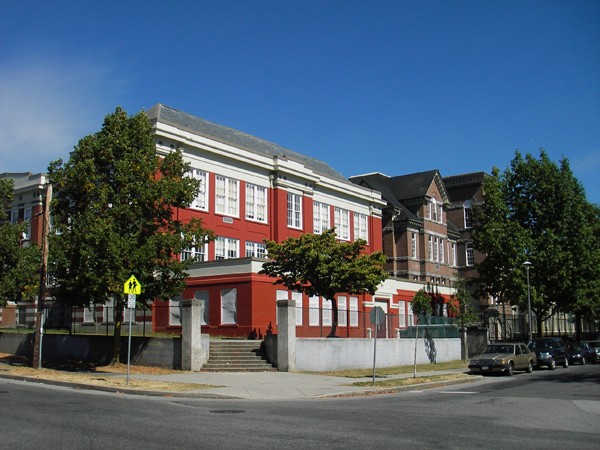
    Strathcona is currently undergoing a significant seismic upgrade project and was identified as needing about $2.5 million in (additional) routine capital upgrades: roof and window replacement, boiler replacement and mechanical upgrades.

    As the VSB’s Manager of Maintenance and Construction points out in his report: “This work would otherwise be more costly to complete at a later date following completion of the seismic project.”

    The decision to overlook Strathcona is even more baffling given that the Ministry of Education had previously identified that “maintenance submissions related to current seismic upgrades would be preferred”.

    If you’ve seen Strathcona Elementary lately, it’s a major construction site. It seems obvious that it would be timely and cost-effective to perform additional upgrades concurrent with that work. So why is a cash-strapped Ministry passing on the cash-strapped school board’s request for budget-conscious upgrades that will otherwise need to be done later at greater cost? Is this the best value for BC tax-payers?

    Seems a short-sighted short-changing indeed.

    Photo: Mike Martin Wong

  • Viaducts removal and Vancouver’s eastern expansion

    Viaducts removal and Vancouver’s eastern expansion

    Thursday October 27, a milestone in a several year personal and community struggle was achieved.

    Vancouver City Council approved an amended staff report to remove the viaducts in principal, with the inclusion of a serious commitment to immediate downgrading of Prior Street and a new east-west arterial, as well as meaningfully honouring of Hogan’s Alley and the black community displaced from there. — Still there is more work to be done, in particular regarding development and affordable housing, delivery of Creekside Park and the management of traffic in NE False Creek.

    Earlier, I wrote the following op-ed:

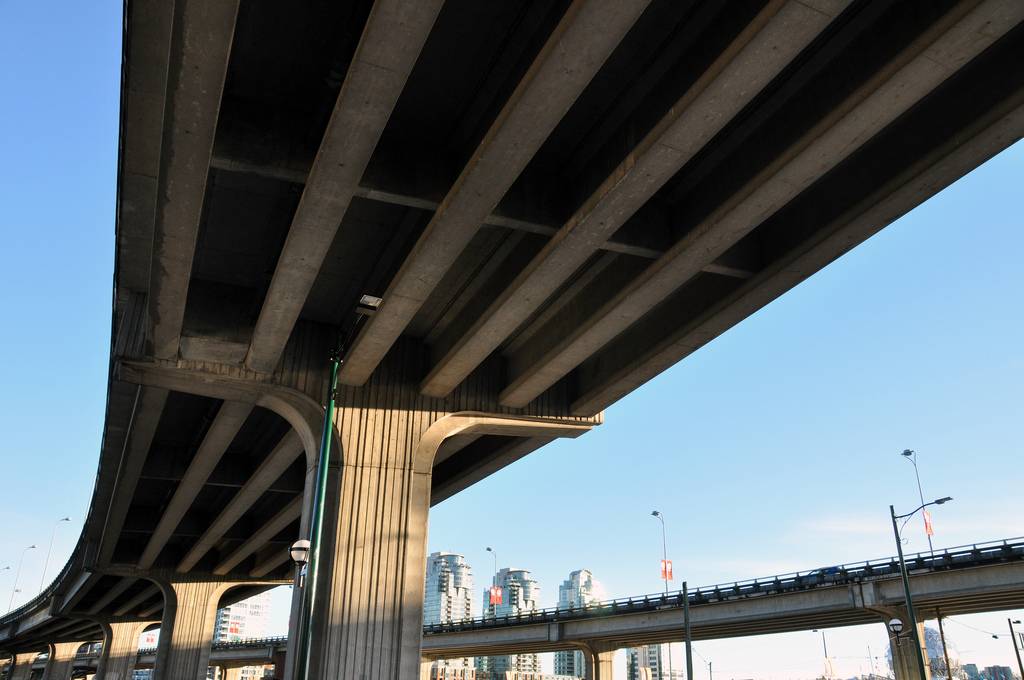
    This week, Vancouver City Council is expected to vote on removing the Georgia and Dunsmuir viaducts—although as many City Hall watchers suggest: It is already a done deal. The proposal to remove the viaducts has been an ongoing issue for several years now; one that has piqued concern and activism in neighbouring communities.

    As many of us have been advocating for years: if we are going to remove the viaducts, let’s do it right.

    (*Full disclosure: my political genesis was viaducts removal. After losing a close friend and neighbour to unsafe Prior Street traffic conditions, I’ve been advocating for safety improvements east of Main to be included in the viaducts planning.)

    The removal of the viaducts is supposed to open up some 2.5 million square feet of residential and commercial development, provide new green space, and add thousands of new residents. More importantly, the development of Northeast False Creek is key to the eastward migration of Downtown Vancouver—an inevitability that urbanists and realtors have been describing for decades. 

    At his 2015 Urban Development Institute address, Vancouver’s pre-eminent real estate marketer Bob Rennie described “big game changers” that will trigger the movement of the city centre east. Bold moves like the relocation of St. Paul’s Hospital to the False Creek Flats, and the removal of the viaducts are two of those game changers. But in any game changer, there are winners and losers. 

    The winners, of course, will be the developers and landowners who stand to immediately benefit from viaducts removal. Concord Pacific who own and will develop much of that land; the Crown Corporation PavCo and the City itself have significant holdings that will open up; and Ian Gillespie’s district energy company has inked a deal with the City to provide heat for all new development in the area. 

    Optimistically, Vancouverites could be big winners if this project is done right—but the losers might well be the most vulnerable in our population, particularly as development puts the squeeze on housing affordability and new road networks bring more traffic.

    Here are some caveats I outlined before council at first reading of the city staff report on October 21.

    First, the City must commit to traffic management east of Main Street as part of the viaducts’ removal.

    One of the biggest concerns expressed by commuters and businesses is that viaducts removal will exacerbate congestion. According to the report, however, the proposed viaducts replacement road—a new at-grade “grand boulevard”—will accommodate viaducts and existing Pacific and Expo traffic streams, while actually increasing road capacity.

    The City’s report offers no commitment to address that traffic flow beyond Northeast False Creek, however. To the east: the communities of Strathcona, Grandview–Woodland, the Downtown Eastside, and Chinatown lack the road infrastructure to accommodate the traffic from the new post-viaducts street network and millions of square feet of new development. 

    As the plan currently outlines, the new Pacific Boulevard will connect to Prior Street. Prior, a narrow neighbourhood street without the setbacks and width expected of an arterial road, is the unfortunate legacy of the proposed freeway system that citizens managed to stop in the 1970s.

    An In-Service Road Safety Review of Prior and Venables (prepared for the City in September by Urban Systems and Morr Transportation Consulting) concedes: “the collisions occurring along Prior Street are involving a higher number of vulnerable road users than other comparable corridors and are potentially more severe.” 

    Of course, locals recognize the inherent danger for vulnerable road users outlined in the road safety review, and seemingly everyone knows someone who has been touched by reckless commuters racing through our neighbourhood. In Strathcona, parents won’t allow children to cross the busy street to the park as unsafe speeds and the running of red lights are all too common; in Grandview–Woodland, the same sort of situation manifests itself along Victoria Drive north of First.

    The report before council does acknowledge the need to secure a new east-west arterial route, but defers that to an indeterminate plan to be considered in 2016 and contingent on securing senior government funding. In the meantime, uncertainty over the how or where of a new arterial is cause for concern among residents and businesses. We ask that the wording of the report reflect that those details be established before the viaducts are removed. 

    Second, delivery of affordable and social housing must be guaranteed. 

    Proponents of viaducts removal point to this as a great opportunity to build affordable housing, and indeed it could be—but the delivery of social housing relies on a complicated shell game.

    Concord’s land development is contingent on former landowners (the province of B.C.) removing contaminated soil. In turn, if the City of Vancouver awards significant and sufficient densities to developers Concord, some degree of profit will be shared with the Province, which the City hopes will be directed to social housing.

    If you aren’t confused yet, consider that profits will have to factor in the Developer Cost Levies and Community Amenity Contributions (CACs); the latter, paid by the developers, is negotiated behind closed doors and will be expected to help cover the cost of viaducts removal, parks, seawall, and a new road network.

    At a recent SFU City Conversations on the subject, noted urban planner Lance Berelowitz questioned whether the math could work to deliver all the promises via CACs. One thing is for sure: if we are to extract maximum public benefit, these as-yet-to-happen negotiations need to be transparent.

    Among the parcels for redevelopment, city-owned land is being considered for sale in order to finance viaducts removal and housing. The city has previously shown leadership in advocating for a housing land trust—and these locations would be a wonderful opportunity to build leasehold public housing on city-owned land.

    On the blocks flanking Main Street in particular, the City could further honour the black community of Hogan’s Alley who were displaced to make way for the viaducts, by embracing the idea of retaining public ownership of the land rather than selling it to the highest bidder. 

    The future of the viaducts land, St. Paul’s Hospital, and the Flats, together with development in Chinatown and the Downtown Eastside, are putting extraordinary pressure on housing. We need to advocate at all three levels of government to ensure that we are protecting residents from displacement and be much more proactive in the building of affordable and social housing. 

    The city knows they cannot build this housing alone, and the staff report details the negotiations that must happen with senior governments. However, the City must ensure that their plan includes real and achievable targets in writing, along with a meaningful commitment to delivering affordable housing, lest we end up with more Olympic Village-style broken promises. 

    If we do it right: with comprehensive traffic management for the East End and a commitment to social and affordable housing; honouring the displacement of the black community at Hogan’s Alley and the diversity and struggle of the area’s low income community; and delivering existing residents their overdue and long-promised Creekside Park; viaducts removal could be a great opportunity for our City. 

    If we do it right.

    Originally published in the Georgia Straight

    Photo by Stephen Hui

  • Strathcona/DTES Disappear on New City Website

    Strathcona/DTES Disappear on New City Website

    Like Many Vancouverites, when the City announced it’s new $3million dollar website last month – I was curious to check it out.

    Sure, it carried a hefty price tag, but then again a content management system of that scale is a lot of work. As I understood they would be using their own custom system, $3 million didn’t seem that unreasonable. Being a graphic and web designer myself, but also as a tax-paying citizen I had to take a look.

    First impressions, meh – ok looking, but given the extent of creative talent in this city I was pretty disappointed. Oh well, it’s a new roll-out, maybe it will improve as time goes on [update note: it didn’t]. But, a website is more than just a pretty looking site – as we say in the biz: content is key.

    So my next stop on the the new website was our neighbourhood page – the hub for info, links, maps, statistics and resources for Strathcona.

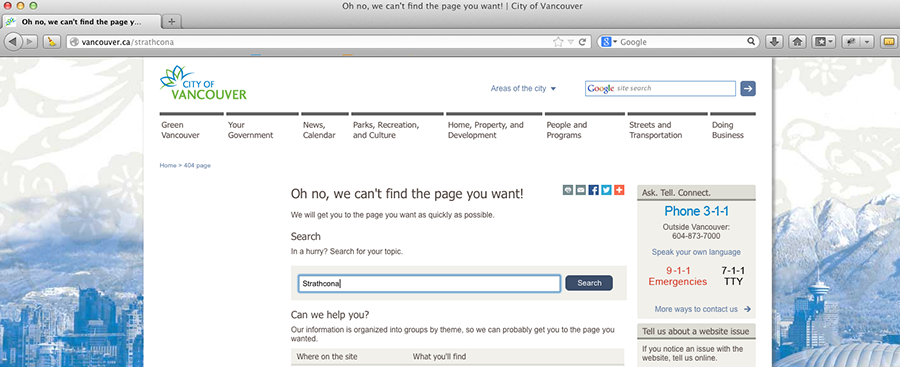
    But when I went looking, I found that our neighbourhood had been disappeared

    Pictured: City of Vancouver’s webpage for Strathcona Hastings
    http://vancouver.ca/green-vancouver/hastings.aspx

    Pictured above is the new webpage on the City’s site, which now defines Strathcona as being within the Hastings area. The Hastings area is described as: “from Downtown to Burnaby, right through the Hastings area, which includes the historic neighborhoods of Chinatown, Strathcona, Gastown, and Downtown Eastside, and other residential areas.”

    So not only was Strathcona gone, but so was the entire Downtown Eastside — and with them, the very identities of Vancouver’s founding neighbourhoods

    Pictured: former Strathcona page, now disappeared from City’s website

    It bears mentioning that these neighbourhoods are also hotbeds of activism, and areas being specifically targetted for urban renewal.

    From the Chinatown Historic Area Heights Review which would see the incursion of high-rise condo towers, to the upcoming Downtown Eastside Local Area Plan which is widely being seen as a prelude to massive redevelopment of the area – there are big changes afoot for the neighbourhoods. Eliminating the identities of the neighbourhoods could be seen as a first volley in a move to first disempower, then redefine the area as part of a larger redevelopment scheme.

    Plato is said to have once proclaimed: “those who tell the stories also hold the power”. 

    The basis of negationism, or historical revisionism is to twist and obscure the truths of the past in order to manipulate information or opinion. Strathcona has been very vocal and assertive, standing in the way of the City’s viaduct removal and redevelopment scheme, the Downtown Eastside has long been a hotbed of anti-gentrifiction activism. What better way to eliminate and delegitimize that opposition than eliminate their very identities.

    It bears mentioning that these neighbourhoods are also hotbeds of activism, and areas being specifically targetted for urban renewal.

    From the Chinatown Historic Area Heights Review which would see the incursion of high-rise condo towers, to the upcomingDowntown Eastside Local Area Plan which is widely being seen as a prelude to massive redevelopment of the area – there are big changes afoot for the neighbourhoods. Eliminating the identities of the neighbourhoods could be seen as a first volley in a move to first disempower, then redefine the area as part of a larger redevelopment scheme.

    Plato is said to have once proclaimed: “those who tell the stories also hold the power”. 

    The basis of negationism, or historical revisionism is to twist and obscure the truths of the past in order to manipulate information or opinion. Strathcona has been very vocal and assertive, standing in the way of the City’s viaduct removal and redevelopment scheme, the Downtown Eastside has long been a hotbed of anti-gentrifiction activism. What better way to eliminate and delegitimize that opposition than eliminate their very identities.

    I imagine as the DTES Local Area Plan unfolds, the disappearance of these neighbourhoods will make more sense – I predict subtle, yet profound changes to established geographic boundaries and zoning areas.

    In the meantime, check out the former community web-pages, which I tracked down on the still operational and unofficial “former” website for the City of Vancouver Strathcona: http://former.vancouver.ca/COMMUNITY_PROFILES/strathcona/index.htm
    DTES: http://former.vancouver.ca/community_profiles/downtown_eastside/index.htm
    DTES Revitalization (Strathcona, Chinatown, Gastown, Victory Square, Oppenheimer/Japantown):
    http://former.vancouver.ca/commsvcs/planning/dtes/index.htmPostscript: 

    Postscript: I followed up on this with City Staff working on the DTES Local Area Plan – and was informed the decision was “corporate”. Which I suppose will require some sort of FOI to get to the bottom of why our neighborhoods have been disappeared…

  • What does the City’s viaduct plan say about Prior Street?

    What does the City’s viaduct plan say about Prior Street?

    So what does the City’s viaduct removal plan say about traffic calming on Prior Street?

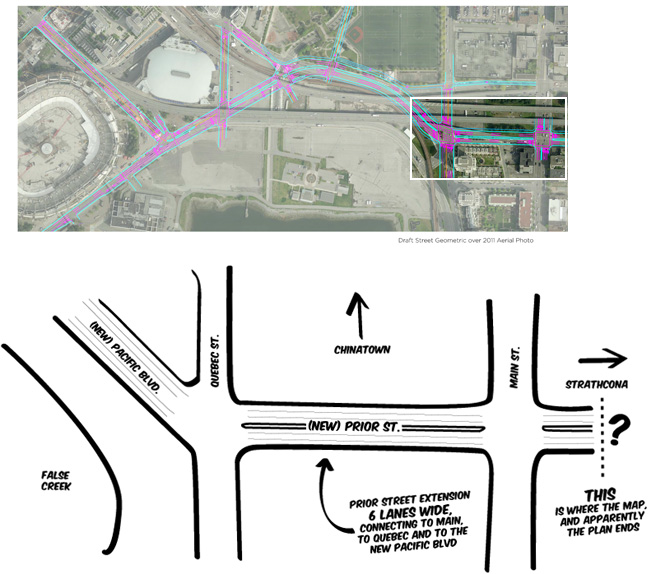
    Unfortunately for Strathcona – not a lot. In fact, the map illustration shows a new six-lane Prior Street extension that connects to Main Street, Quebec Street and a new expanded six-lane Pacific Boulevard ends before Gore – with no details about what happens to those six lanes of traffic east of Main. Prior street is identified as the “direct east-west link to the downtown for commuter vehicles and large goods-movement trucks” *.Pacific Boulevard is combined with Expo north of the Skytrain guideway and connects east to Prior/Venables thereby maintaining a direct east-west link to the downtown for commuter vehicles and large goods-movement trucks.From the City’s Viaduct Open House presentation boards, p.14, May-June 2012

    The above illustration has been adapted illustrated for clarity. It details the new Prior Street extension as outlined in the City proposal’s draft street geometric / arial photo (pictured top). Traffic planning typically considers the path of least resistance, apparently drivers prefer not to turn if presented an option. By that token it would appear that Pacific Boulevard traffic is directed to/from Prior St – as it is a more direct route. This might be evidenced by the statement on page 8 of the City’s document “Connecting Georgia to New Pacific to Prior/ Venables preserves essential east-west capacity in and out of the Downtown as well as goods movement routing.”Connecting Georgia to New Pacific to Prior/ Venables preserves essential east-west capacity in and out of the Downtown as well as goods movement routing.From the City’s Viaduct Open House presentation boards, p. 8, May-June 2012

    Ostensibly, the City’s development of Prior and extension to Pacific is part of a larger Eastern Core Strategy which offers “In the future, the new Pacific Boulevard is designed to connect to Malkin Avenue allowing an opportunity to downgrade Prior/Venables to a local street.” HOWEVER, there is no timeline or commitment for such a strategy which would theoretically be subject to changing political and development directions. Implementation of an Eastern Core Strategy could be years if not decades away. The City does have a number of other options at it’s disposal that do not involve increasing traffic on Prior.Window of Opportunity …Once development proceeds, the flexibility of options will be minimized and the opportunity to change the street structure will be lost.From the City’s Viaduct Open House presentation boards, p. 2, May-June 2012

    Why Should We Care?

    The single greatest impact of the viaducts on Strathcona is and always has been the intolerable level of traffic it directs onto Prior Street.

    • Prior Street divides our community and separates us from our park and community gardens. Homes and seniors’ residences to the South of Prior are separated from shopping and recreation in Strathcona and Chinatown.
    • Prior Street poses a significant long term and short term safety and health risk to residents of Strathcona. Red-light-running is common. High levels of commuter and truck traffic mean residents living on Prior Street are subjected to increased traffic pollutants and noise.According to the California Department of Public Health People who live close to busy roads may be at higher risk for exposure to traffic pollutants. Health risks associated with exposure to traffic pollutants (specifically diesel particulate matter, nitrogen oxides, carbon monoxide and volatile organic compounds) include increased rates of cancer, asthma, heart disease, lung inflammation, decreased mental alertness, allergies and premature death. The California Department of Public Health defines a busy road as having more than 10,000 vehicles drive on it each day. According to the most recent City of Vancouver traffic counts available (VanMap: 400 block Prior, April 3, 2008) Prior Street handles 19,746 vehicles per day.
    • The City has shamelessly invoked and exploited Strathcona’s historic fight to stop the city planners and developers who would have bulldozed our community forty years ago. We owe it to those who came before us, and to future generations who will come after us to to preserve the hard-fought for neighbourhood we love.

    Council will be voting on the viaduct removal plan in July.
    We have a limited window of opportunity to send a loud and very clear message that we demand traffic calming on Prior Street.

    Postscript: I originally posted this item as Chair of the Strathcona Residents Association – more info about the Viaducts and Strathcona scan be found on the SRA website