Author: P F

  • A better city together One community at a time and with a little help from our neighbours to the south

    A better city together One community at a time and with a little help from our neighbours to the south

    MY NAME’S PETE Fry. I’m a creative professional, entrepreneur and community activist, and I’m running for city council with the Green Party of Vancouver.

    I’ve been self-employed most of my adult life with clients ranging from the DIY indie music and club scenes to government and NGOs to arts and activists, but mostly I’ve worked with small businesses across Vancouver.

    Small businesses provide 80 percent of this city’s jobs, yet many are suffering due to ham-fisted rezonings and development; exorbitant taxes and property values; lack of a cohesive urban plan; and too much red tape. Along with my park board running mate, restaurateur Michael Wiebe, we’re excited to bring a front-line small business perspective to the Greens and this civic election.

    I’m also a community activist in my neighbourhood, Strathcona and the DTES, where I’ve lived since 1988. Most recently as chair of the Strathcona Residents’ Association, I advocated for the community in the Local Area Planning Process but I’ve also been very active regarding the proposed viaduct removal, safety, housing and heritage retention, as well as helping to raise money and grants.

    I’ll get this out of the way now because a lot of people ask me: Yes, my mom is Hedy Fry, Vancouver Centre MP since 1993. No, I didn’t grow up around political campaigns—I was in my mid-20s when she was elected and I’d long since left home.

    But like me, mom was a political neophyte when she first ran. Like me, she was running because she saw that something was rotten and needed fixing. In her case, it was the issue of same-sex partner rights. For me, it’s the state of Vancouver—slick, developer-funded, world class city building without the jobs, the affordability, the community or the infrastructure citizens actually need.

    To say at one point that I had distanced myself from my mom’s political career would be an understatement. I’m proud of what she’s accomplished for the LBGTQ community but as an artist, entrepreneur and iconoclast I wanted nothing to do with it.

    Running for public office wasn’t part of my plan, but all that changed after several years of community activism and butting heads with City Hall over citizens’ and neighbourhoods’ roles in decisions—more, the lack of that.

    Community engagement is not an “easy thing”. Even with proper representation it risks the tyranny of the majority, NIMBYism and resistance to change. But community engagement is the “right thing”. It’s the basis, literally, of democracy—the rule of the people.

    What is community engagement? Let’s start with what it is not. It’s not random selections of citizens taking direction from the top; it’s not sticky notes and roundtables to record and ignore. Community engagement is an opportunity to involve citizens meaningfully in the decisions that affect their lives.

    I recently travelled to Portland, Oregon, to see how they do things differently, and how that might apply to Vancouver. I met with planners, urbanists, business owners, housing activists, neighbourhood associations and city officials. I could write several articles on what I discovered there: affordable, human-scale housing initiatives; small business incubation; robust multi-modal transportation and genuine place making.

    But what really drew me in was the Office of Neighbourhood Involvement.

    The Office of Neighbourhood Involvement (charmingly located in the main foyer of City Hall) helps facilitate citizen/government relations. Established in 1974, their mission is to “Promote a culture of civic engagement by connecting and supporting all Portlanders working together and with government to build inclusive, safe and livable neighborhoods and communities.”

    There are 96 recognized neighbourhood associations in Portland. They get some funding and logistical assistance from the city, are expected to uphold standards of inclusivity and fair representation, They also have an active role in city governance.

    As counterintuitive as it may seem, studies show that if people aren’t totally dependent on government, they like it better and government is more effective. But without meaningful public involvement, there is an increased dependency on government institutions, who in turn are overwhelmed by demands for services.

    Arguably, this is the case here in Vancouver, where community consultation is often decried as an expensive time waster, overwhelming and unwieldy for staff and policy makers.

    Typically, our Vancouver consultation model is provided not as a collaborative opportunity, but as a pedantic, micro-managed process, that on one hand validates itself through citizen involvement, yet actively disempowers citizen input—meaning, the public have no responsibility for the decisions being made.

    Involvement doesn’t mean that citizen groups automatically “get what they want” but that they are engaged participants in the process, and invested in the solutions.

    In Portland, that involvement permeates all aspects of government and apparently begets a compassionate and informed populace. Every Portlander I spoke to appreciated both the work of the Office of Neighbourhood Involvement in enhancing the role of citizens and small business in decision making, and the wildly popular former mayor, Bud Clark.

    Clark, a tavern owner and community activist, ran an underdog campaign against a big money opponent, and is largely responsible for the spirit of community activism and its integration in the running of the city, and in government’s responsibility to citizens.

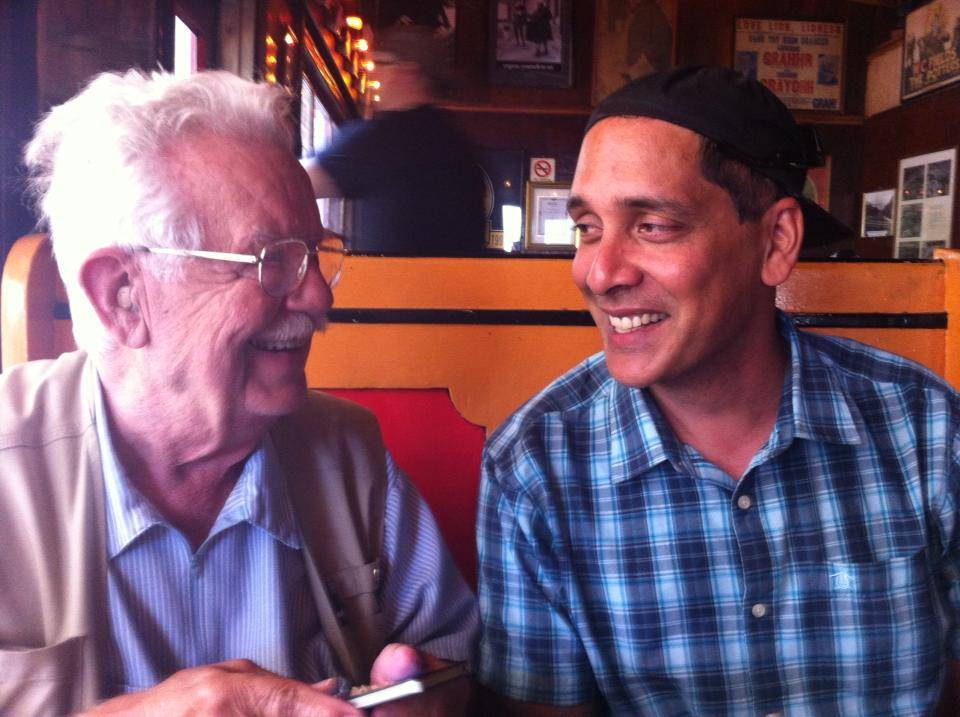
    I was lucky enough to meet Bud for a pint, and asked him what makes his city so great: he couldn’t give a definitive answer, but when I suggested it’s the people not the planners, he agreed—it’s the people for sure. And with that he wished me luck in my campaign to bring that same spirit to Vancouver.

    Pete Fry is a Green candidate for Vancouver city council. He is former chair of the Strathcona Residents’ Association and was a community representative on the city’s DTES Local Area Plan.Postscript: 

    Originally published in the Georgia Straight http://www.straight.com/news/761236/pete-fry-better-city-together
  • Strathcona/DTES Disappear on New City Website

    Strathcona/DTES Disappear on New City Website

    Like Many Vancouverites, when the City announced it’s new $3million dollar website last month – I was curious to check it out.

    Sure, it carried a hefty price tag, but then again a content management system of that scale is a lot of work. As I understood they would be using their own custom system, $3 million didn’t seem that unreasonable. Being a graphic and web designer myself, but also as a tax-paying citizen I had to take a look.

    First impressions, meh – ok looking, but given the extent of creative talent in this city I was pretty disappointed. Oh well, it’s a new roll-out, maybe it will improve as time goes on [update note: it didn’t]. But, a website is more than just a pretty looking site – as we say in the biz: content is key.

    So my next stop on the the new website was our neighbourhood page – the hub for info, links, maps, statistics and resources for Strathcona.

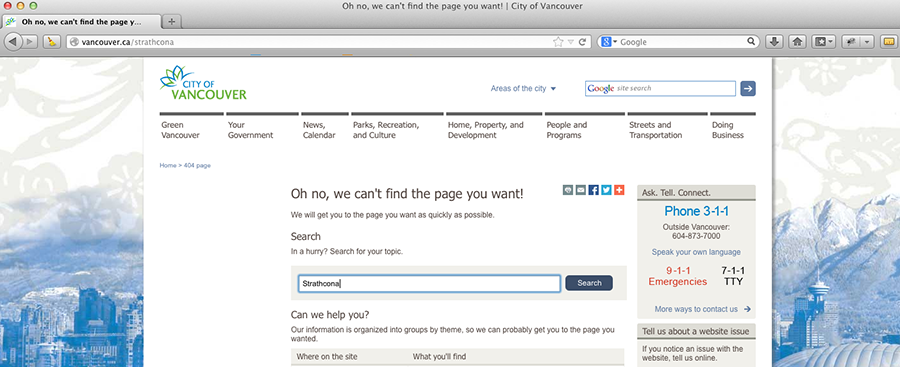
    But when I went looking, I found that our neighbourhood had been disappeared. 

    Pictured: City of Vancouver’s webpage for Strathcona Hastings
    http://vancouver.ca/green-vancouver/hastings.aspx

    Pictured above is the new webpage on the City’s site, which now defines Strathcona as being within the Hastings area. The Hastings area is described as: “from Downtown to Burnaby, right through the Hastings area, which includes the historic neighborhoods of Chinatown, Strathcona, Gastown, and Downtown Eastside, and other residential areas.”

    So not only was Strathcona gone, but so was the entire Downtown Eastside — and with them, the very identities of Vancouver’s founding neighbourhoods

    Pictured: former Strathcona page, now disappeared from City’s website

    It bears mentioning that these neighbourhoods are also hotbeds of activism, and areas being specifically targetted for urban renewal.

    From the Chinatown Historic Area Heights Review which would see the incursion of high-rise condo towers, to the upcoming Downtown Eastside Local Area Plan which is widely being seen as a prelude to massive redevelopment of the area – there are big changes afoot for the neighbourhoods. Eliminating the identities of the neighbourhoods could be seen as a first volley in a move to first disempower, then redefine the area as part of a larger redevelopment scheme.

    Plato is said to have once proclaimed: “those who tell the stories also hold the power”. 

    The basis of negationism, or historical revisionism is to twist and obscure the truths of the past in order to manipulate information or opinion. Strathcona has been very vocal and assertive, standing in the way of the City’s viaduct removal and redevelopment scheme, the Downtown Eastside has long been a hotbed of anti-gentrifiction activism. What better way to eliminate and delegitimize that opposition than eliminate their very identities.

    It bears mentioning that these neighbourhoods are also hotbeds of activism, and areas being specifically targetted for urban renewal.

    From the Chinatown Historic Area Heights Review which would see the incursion of high-rise condo towers, to the upcomingDowntown Eastside Local Area Plan which is widely being seen as a prelude to massive redevelopment of the area – there are big changes afoot for the neighbourhoods. Eliminating the identities of the neighbourhoods could be seen as a first volley in a move to first disempower, then redefine the area as part of a larger redevelopment scheme.

    Plato is said to have once proclaimed: “those who tell the stories also hold the power”. 

    The basis of negationism, or historical revisionism is to twist and obscure the truths of the past in order to manipulate information or opinion. Strathcona has been very vocal and assertive, standing in the way of the City’s viaduct removal and redevelopment scheme, the Downtown Eastside has long been a hotbed of anti-gentrifiction activism. What better way to eliminate and delegitimize that opposition than eliminate their very identities.

    I imagine as the DTES Local Area Plan unfolds, the disappearance of these neighbourhoods will make more sense – I predict subtle, yet profound changes to established geographic boundaries and zoning areas.

    In the meantime, check out the former community web-pages, which I tracked down on the still operational and unofficial “former” website for the City of Vancouver Strathcona: http://former.vancouver.ca/COMMUNITY_PROFILES/strathcona/index.htm
    DTES: http://former.vancouver.ca/community_profiles/downtown_eastside/index.htm
    DTES Revitalization (Strathcona, Chinatown, Gastown, Victory Square, Oppenheimer/Japantown):
    http://former.vancouver.ca/commsvcs/planning/dtes/index.htmPostscript: 

    Postscript: I followed up on this with City Staff working on the DTES Local Area Plan – and was informed the decision was “corporate”. Which I suppose will require some sort of FOI to get to the bottom of why our neighborhoods have been disappeared…

  • What does the City’s viaduct plan say about Prior Street?

    What does the City’s viaduct plan say about Prior Street?

    So what does the City’s viaduct removal plan say about traffic calming on Prior Street?

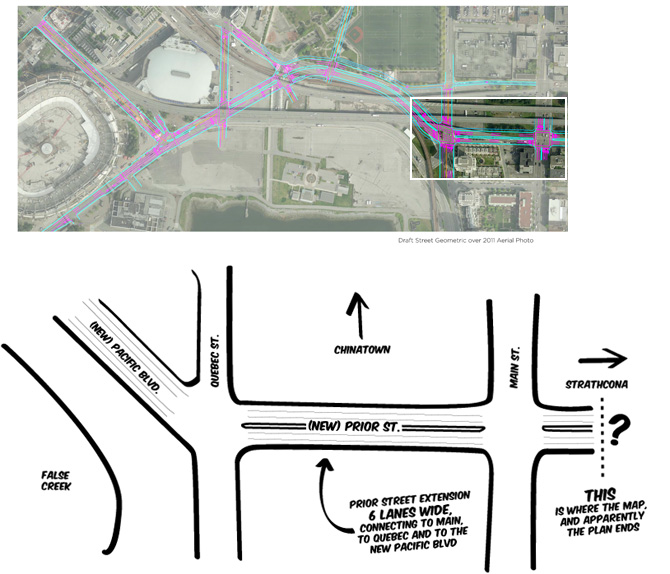
    Unfortunately for Strathcona – not a lot. In fact, the map illustration shows a new six-lane Prior Street extension that connects to Main Street, Quebec Street and a new expanded six-lane Pacific Boulevard ends before Gore – with no details about what happens to those six lanes of traffic east of Main. Prior street is identified as the “direct east-west link to the downtown for commuter vehicles and large goods-movement trucks” *.Pacific Boulevard is combined with Expo north of the Skytrain guideway and connects east to Prior/Venables thereby maintaining a direct east-west link to the downtown for commuter vehicles and large goods-movement trucks.From the City’s Viaduct Open House presentation boards, p.14, May-June 2012

    The above illustration has been adapted illustrated for clarity. It details the new Prior Street extension as outlined in the City proposal’s draft street geometric / arial photo (pictured top). Traffic planning typically considers the path of least resistance, apparently drivers prefer not to turn if presented an option. By that token it would appear that Pacific Boulevard traffic is directed to/from Prior St – as it is a more direct route. This might be evidenced by the statement on page 8 of the City’s document “Connecting Georgia to New Pacific to Prior/ Venables preserves essential east-west capacity in and out of the Downtown as well as goods movement routing.”Connecting Georgia to New Pacific to Prior/ Venables preserves essential east-west capacity in and out of the Downtown as well as goods movement routing.From the City’s Viaduct Open House presentation boards, p. 8, May-June 2012

    Ostensibly, the City’s development of Prior and extension to Pacific is part of a larger Eastern Core Strategy which offers “In the future, the new Pacific Boulevard is designed to connect to Malkin Avenue allowing an opportunity to downgrade Prior/Venables to a local street.” HOWEVER, there is no timeline or commitment for such a strategy which would theoretically be subject to changing political and development directions. Implementation of an Eastern Core Strategy could be years if not decades away. The City does have a number of other options at it’s disposal that do not involve increasing traffic on Prior.Window of Opportunity …Once development proceeds, the flexibility of options will be minimized and the opportunity to change the street structure will be lost.From the City’s Viaduct Open House presentation boards, p. 2, May-June 2012

    Why Should We Care?

    The single greatest impact of the viaducts on Strathcona is and always has been the intolerable level of traffic it directs onto Prior Street.

    • Prior Street divides our community and separates us from our park and community gardens. Homes and seniors’ residences to the South of Prior are separated from shopping and recreation in Strathcona and Chinatown.
    • Prior Street poses a significant long term and short term safety and health risk to residents of Strathcona. Red-light-running is common. High levels of commuter and truck traffic mean residents living on Prior Street are subjected to increased traffic pollutants and noise.According to the California Department of Public Health People who live close to busy roads may be at higher risk for exposure to traffic pollutants. Health risks associated with exposure to traffic pollutants (specifically diesel particulate matter, nitrogen oxides, carbon monoxide and volatile organic compounds) include increased rates of cancer, asthma, heart disease, lung inflammation, decreased mental alertness, allergies and premature death. The California Department of Public Health defines a busy road as having more than 10,000 vehicles drive on it each day. According to the most recent City of Vancouver traffic counts available (VanMap: 400 block Prior, April 3, 2008) Prior Street handles 19,746 vehicles per day.
    • The City has shamelessly invoked and exploited Strathcona’s historic fight to stop the city planners and developers who would have bulldozed our community forty years ago. We owe it to those who came before us, and to future generations who will come after us to to preserve the hard-fought for neighbourhood we love.

    Council will be voting on the viaduct removal plan in July.
    We have a limited window of opportunity to send a loud and very clear message that we demand traffic calming on Prior Street.

    Postscript: I originally posted this item as Chair of the Strathcona Residents Association – more info about the Viaducts and Strathcona scan be found on the SRA website

  • Digging in the Crates : Posters

    Digging in the Crates : Posters

    Like the cobbler’s kids not having shoes – I’ve notoriously neglected to document or promote my own design and illustration work, despite over 25 years of successful and award winning self employment. Poster work was what first got me into design, as a natural extension of drawing comics since my teens. While posters where my first love, I must confess I haven’t done many posters for at least 15 years now. Most of these pre-date cheap color printing and widespread web use, some even pre-date digital output and most are from stacks of undigitized paper archives- posted here as a small snapshot of 1990’s Vancouver indie scene.

    I’ll keep adding as I unearth more archives. Here’s a sampler, in no particular order, filed under posters:

  • On Dog Waste, Yellow Journalism and What to Doo About It.

    On Dog Waste, Yellow Journalism and What to Doo About It.

    Drinking my morning coffee, I listened to the CBC radio follow up on their recently posted story about the scourge of uncollected dog feces throughout Vancouver. According to the CBC, the problem is so widespread that it is set to break the City’s records for the most amount of complaints received in any single year. Of course, no one likes to step in dog shit, and the rant-line messages re-enforce that reality as a second day’s worth of angry callers launch into tirades about horrible dog owners.

    A record breaking number of complaints, I think to myself, that must be a lot of dog doo. I watch the CBC report with interest: that record breaking number of complaints? Forty-five. That’s right, 45 complaints – possibly set to break last year’s record of (wait for it) forty-eight complaints.

    I’ll readily admit that dog shit in our parks and on our sidewalks in unacceptable, and an understandably infuriating and disgusting problem for anyone who steps in or has to clean it up – presumably even more so if you don’t actually own a dog. It’s an issue the media loves to capitalize on because it elicits such emotional reactions. But really, forty-five complaints in 11 months, that’s news? To my mind, stories like this are the worst kind of Yellow Journalism, a cheap ploy to engage the audience by way of exaggeration and sensationalism. The problem with this kind of sloppy and inflammatory reporting of course, is that it polarizes the issue and pillories all dog owners, tarring them with one generalized brush stroke of antisocial irresponsibility.

    But let’s take a look at the numbers – by the City’s own estimates there are 140,000 dogs in Vancouver (with only 30,000 of them licensed, but that’s another story). For argument’s sake: let’s assume that the city is wildly off base with their estimate and there are only 50,000 dogs in the city. Let’s make another big assumption and say that half of those dogs never leave their home or yard and effectively only 25,000 dogs are walked on our city street and parks. Of those 25,000 dogs let’s pretend that they only make one bowel movement a day. Twenty-five thousand dogs multiplied by 365 days – that’s over nine MILLION dog turds per year! If dog owners were overwhelmingly irresponsible – this city would be literally swimming in dog shit. Even if 5% of our low-balled urban dog population were irresponsible and failed to collect after their dog, that’d be half a million turds per year about 4,000 per square kilometre.

    It becomes abundantly clear when you look at the numbers then, that owners not picking up after their pets is an anomaly, not the rule. The kind of people that don’t pick up are probably the same kind of people that litter, or run red lights or bicycle on the sidewalk – they’re self-centred jerks.

    Now that we’ve identified the problem what do we do about it and what do we do with all the dog waste that IS dutifully collected and deposited in the garbage where it goes on to be entombed in a plastic baggie in a landfill?

    Even if a misanthropic 5% of the owners of our low-balled overall urban dog population were irresponsible and failed to collect after their dog every time they left a deposit, that’d be half a million turds per year or about 4,000 per square kilometre.