Tag: POLITICS

  • Pete Fry: B.C. election could transform development picture, starting with 105 Keefer rezoning

    Pete Fry: B.C. election could transform development picture, starting with 105 Keefer rezoning

    Will the winds of political change bring a breath of fresh air for Chinatown?
    As news broke Monday of the historic NDP-Green deal to form a progressive government for our province, I was waiting at city hall, one of hundreds of speakers over four days testifying before city council in defence of Chinatown.

    I had managed to steal away from work to attend and speak on the final day of public hearings over the proposed Beedie condo development at 105 Keefer Street. I’m glad I attended in-person. The mood was electrifying and inspiring, the gallery and chambers packed with advocates and activists.

    At issue: the rezoning proposal for a new large-scale condo development in the fragile heritage neighbourhood. This latest in a series of rejected applications by Beedie Developments for the block next to the Chinese Classical Gardens and Cultural Centre has been met by resistance every step of the way.

    Chinatown advocates are right to be concerned; after years of neglect, recent big block condo developments in the name of renewal have radically transformed the neighbourhood.

    So far, similar large-scale new developments may have succeeded in bringing new businesses, residents, and short-term vacation rentals to the area, but at a cost: the displacement of low-income seniors, affordable residences and businesses, and the continued erosion of Chinatown’s character and heritage.

    On day one of the public hearings, respected neighbourhood activist Shirley Chan lamented that over the last several years, the development decisions by council were not—as purported—saving Chinatown, but in fact they were replacing Chinatown.

    There is a real irony then, that those same development decisions replacing Chinatown may have succeeded in saving Chinatown after all. Opposition to the project has succeeded in rekindling that most intangible aspect of heritage: it has built real community.

    A huge number of speakers appeared before city council to offer comments on an application for a 12-storey building at 105 Keefer Street.
    A huge number of speakers appeared before city council to offer comments on an application for a 12-storey building at 105 Keefer Street.
    The opposition to this development proposal has managed to bring together young people, old people, heritage advocates and housing activists, small businesses and historic clan associations, multigenerational Canadians with deep roots and recent immigrants contextualizing their own sense of belonging in our city. The opposition to this project has brought about something of a Chinatown renaissance, and ignited a passion to save the neighbourhood.

    A new generation of bright, articulate, and inspired Chinese-Canadian youth and allies have taken up the mantle of the 1970s freeway fighters—organizing and advocating, working with Chinatown seniors, and quite literally breathing new life into the neighbourhood. The same neighbourhood that the city council majority and real estate interests had decided was in need of replacement, underperforming and moribund.

    If there were any grounds of justification for council to still approve this rezoning it wouldn’t be for revitalization, but for public benefits. The provision of truly affordable housing as a public-benefit condition of the various recent big block condo developments in Chinatown so far has been pretty minimal: in the low double digits as far as actual numbers of units.

    This most recent application for rezoning to accommodate the Beedie Group’s new 12-story condo building at 105 Keefer Street offered little by way of public benefits: 25 units of seniors rental housing, only eight of which would be at pension rate, and paid for by B.C. taxpayers. The proposal was also to include a cultural amenity space at “below market rate” (which by definition is not necessarily affordable or accessible).

    As most of the opponents agreed, the public benefits fell well short of what the community needs, and the building came at a significant cost to the neighbourhood. It’s too big, and in the wrong place.

    As I went to speak before council Monday, the news that a Green-NDP deal had been struck just moments earlier presented a literal last minute game-changer. Among other things, both parties have committed to increase the supply of affordable housing.

    That will likely mean that begging for developers’ table scraps will no longer be the only route to securing housing for our society’s most vulnerable.

    With a new provincial mandate, the veritable knife through the heart of Chinatown in exchange for barely-there public benefits will seem a lot less attractive to city councillors going into a 2018 municipal election. Looking forward, any suggestion of developer-donor influence should be put to bed by the NDP-Green commitment to ban big money political contributions (over the 11 months of the 2014 civic election reporting period, Beedie Group and their VP Rafii Houta are listed at having contributed at least $65,000 to Vision Vancouver).

    City council will make a decision on the 105 Keefer application on June 13. Those extraordinary record-breaking four days of public hearings have bought councillors a little extra time to see not only the extent of public opposition to this project in support of Chinatown, but also how the political landscape is changing.

  • Why I voted against the Green Party BDS policy resolution.

    Why I voted against the Green Party BDS policy resolution.

    See this despicable cartoon attached to my post? 
    I didn’t scrape it off some bottom-of-the-internet hate site, this was on the progressive World Social Forum which was happening in Montreal this last weekend.

    Those particular workshops were condemned of course, and later cancelled and pulled from the website— but I think it is important to call out that kind of hate where and when we see it. The fact that it was approved as a committee/workshop and allowed to fester on a progressive website as long as it did? Nobody should be ok with this kind of thing, least of all progressives advocating for human rights. 

    I wanted to give context to one of the reasons why I didn’t support the BDS (Boycott, Divest and Sanction) of Israel policy resolution voted on at the Green Party of Canada’s biannual convention, which quite coincidentally also took place this last weekend, in Ottawa. 

    I’m not suggesting that the GPC members and BDS supporters behind this motion are racist, or wouldn’t be offended by the cartoon —but I won’t sugar coat the idea that there isn’t a growing, ugly undercurrent out there of manipulation, and racism, and intolerance. The rise in (((Anti-Semitism))) and Islamophobia even in progressive circles is a tone eerily similar to the type of xenophobic rhetoric we’re hearing from Trump supporters, European nationalists, Brexiters, and the like.

    When as Greens we formalize support for a position that polarizes around an issue of race, ethnicity, and nationalism we are traveling a dangerous path.

    I didn’t attend the convention, nor am I especially active in the Green Party of Canada, but as a member I voted online some weeks before.

    As someone who has run for political office (twice) under “Green” banners —though not the GPC specifically— I feel I should be clear where I stand. 

    I support a two state solution. 

    I support a free, safe, just, and self-determined nation state for Palestine.

    I support a free, safe, just, and self-determined nation state for Israel.

    I support non-violence as a means to acheive those goals, as I do not support the status quo as it is now.

    But I can’t support the motion passed at the GPC convention in support of BDS movement. 

    I have studied the BNC and the BDS movement, the actual implications of BDS, as well as the positions of Palestinians and others like Noam Chomsky who reject the movement (while still being critical of Israel).

    The BDS movement has a specific stated agenda: The BDS movement calls for a boycott of all Israeli products.

    The GPC policy motion may couch support of BDS in language like: “targeted to those sectors of Israel’s economy and society which profit from the ongoing occupation” —but that language is entirely subjective and utterly meaningless in its lack of specifics, as well as being inconsistent with the stated goals of the BDS movement. While I don’t condone the actions of any belligerents in the Israel-Palestine conflict, I do not think that the BDS movement offers a realistic roadmap to a lasting peace and security in the region.

        Screenshot from BDSmovement.net FAQ page

    So I reject this GPC policy statement for a myriad of reasons: first and foremost because it is guided by the mandate of an outside political organization, and not the least of which because the motion is poorly written. 

    This policy statement lacks the balance and respect for diversity we expect as Greens. This policy statement lacks the context to acknowledge progressive Israeli and Palestinians working towards consensus and peace, or what any targeted boycotts might look like. This policy statement doesn’t explicitly acknowledge and distinguish between complex and nuanced issues of history, racial/religious identity and government. This policy statement lacks the sophistication to specifically consider Canada’s own direct role in Israel’s military-industrial-complex, the ultimate consequences of further squeezing Israel into a nationalist and defensive position and destabilizing a democracy in an already destabilized region, or the implications of abdicating party policy to an outside organization.

    In my opinion, our objectives should be determined by the Green Party, not the BDS movement, and our methods to reach those goals should reflect that iteratively and clearly.

    For the GPC to take policy directions from another political organization (the BDS movement) is as undemocratic as it is untenable, and clearly it is proving to be incredibly divisive.

    I will suggest that as a party we are right to uphold progressive values of human and civil rights, equality, and social justice for everone —regardless of ethnic/religious identity, national origin, colour, gender identity, or sexual orientation. Those values can’t be ad hoc, they must be universal in their application, including right here in Canada.

    That being said, I disagree with any efforts to legislate a prohibition of expressions of support for BDS — respect for opposing views and the conversation they spawn are the only way to fulsome discussion and consensus. 

    I regret that I didn’t post my thoughts on this earlier, but I didn’t actually think GPC members would pass this motion, nor did I think I would have to articulate or defend my own thoughts on the matter. 

    Postscript: 

    Once of the most meaningful and thoughtful opinions on resolving the conflict I’ve read comes from the The Parent’s Circle – A grassroots organization of bereaved Palestinian and Israeli families supporting Peace, Reconciliation and Tolerance.

    “Although the PCFF has no stated position on the political solution of the conflict, most of its members agree that the solution must be based on free negotiations between the leadership of both sides to ensure basic human rights, the establishment of two states for two peoples, and the signing of a peace treaty.” — www.theparentscircle.com

    Post Postscript

    The BDS policy was revisited at a subsequent GPC convention and overturned.

  • The Mount Pleasant by-election candidates on rising rents and legalized pot

    What can we do about the impact of rising rental rates in a neighbourhood whose incomes are increasingly unable to support them?

    We need to be ensuring that we are not relying entirely on the market to supply affordable rental housing. I have long advocated that we need to extract more value from the property transfer tax system and the commodification of our local real estate and start investing that. Right now, $1.4 billion in property taxes from last year alone is going into general revenue, but I would like to see it going into housing. I’d like to see property transfer taxes tweaked to address speculators, foreign corporate investors, luxury properties and enhance that revenue by putting it into building new housing and subsidize the building of new public housing and rental housing.

    I would also like to see us start looking towards the model that we see in Ontario, Quebec and Manitoba with the renters tax credit. In those provinces, and increasingly in the U.S., renters who are paying high rents can actually declare their rents on their income tax and receive some kind of credit or rebate at tax time. What we see in Vancouver Mount-Pleasant where we have three-quarters of the riding in rent is that an extremely high proportion of them are paying more than 50 percent of their income when the benchmark is supposed to be 30 percent. Obviously there is a disconnect, and we need to insure that housing affordability is made available to the people that live and work here because it is vital to our quality of life and local economy. Vancouverites need to actually be able to afford to live where they work.

    Marijuana Dispensaries abound in the riding. What can be done to integrate them more successfully into the community?

     I’m not sure what you mean by “integrate them more successfully into the community.” I mean, they are what they are, and in the end it’s a business model. I don’t think we can look at how we necessarily integrate businesses like pharmacies or any kind of special dispensaries; they are just a very specialized market. I think that we should enhance and protect bubble zones around vulnerable populations, so I don’t think we should have dispensaries too close to schools or community centers. Of course they should be operating within the scope of the law, and I know that there have been some really top-drawer operations and some that are a little bit shady and we need to regulate, tax and monitor these with the utmost discretion. It is a controlled substance and there is the risk of criminality or whatever might come with it, so I think we need to be on top of that. Otherwise, I would not want to see them more integrated into normal society. I think it is probably fine the way it is, as far as integration goes.

    What is the one policy change you would push for as the MLA for the riding?

    Aggressive movement on housing affordability. That is 100 percent the biggest issue for me. We have a lot of pressure coming on to this riding in particular, a lot of big projects happening, and these things combined bring about a lot of change that risks a lot of displacement. We have the viaducts removal, we have the new St. Paul’s Hospital, we have the Broadway Subway, and all three of those projects are massive game changers for this riding that are going to bring a lot of development and money. We really need to be on top of this housing affordability issue as we embrace these new changes, because if we don’t we are going to displace a lot of people. We will only see our homeless numbers go up, we will see more stress and family dysfunction, and it will compromise the health and well being of Vancouverites. It’s important that we have communities where everybody can live and thrive and socioeconomic diversity is a big part of that, which housing is at the root of.


    Read Full Article: http://vanmag.com/city/mount-pleasant-by-election-candidates/

  • International Day of Disabled Persons

    International Day of Disabled Persons

    Today, December 3rd marks the International Day of Disabled Persons (first declared by the United Nations in 1992). On that note – it seems appropriate to talk about disabilities and accessibility in B.C.

    It’s impossible to talk about accessibility barriers in this province without first talking about disability rates. There are two different qualifications: Persons With Disability (PWD) and Persons with Persistent and Multiple Barriers to employment (PPMB). PWD is a semi-permanent designation, and a single PWD can receive up to $906.42/month. A single PPMB can receive a maximum of $657.92 and must reapply every two years. There are potential additional supplements available for nutritional, diet, transportation, and crisis needs at the Ministry’s discretion. Both benefits are inclusive of a maximum shelter expenditure of $375/month.

    Of course, in Vancouver-Mount Pleasant, where the average rent for a bachelor apartment is $889/month, a $375 shelter maximum seems perversely inappropriate — and thus we find disability-collecting citizens living in slum hotels with no heat or hot water, or shut-in by broken elevators. Coupled with ongoing cuts to health services (I recently wrote about Vancouver Coastal Health laying off 89 home care workers for disabled and elderly) our province is condemning many of society’s most vulnerable to absolute misery.

    It’s clear that we must raise the rates of social assistance. Leading advocates in the field including Disability Alliance of BC’s Disability Without Poverty Network call for increasing the PWD benefit to $1200/month. There’s no indication that either the BC Government or Opposition seem interested in raising assistance rates though — the Liberals haven’t raised the basic welfare rate ($610) since 2007, and the NDP’s paltry $20/month increase proposed in their most recent platform indicate neither are listening to experts.

    Of course, not all disabled people collect assistance – indeed many are productively and well-employed, and they rightly deserve to be viewed as capable. But capability is predicated by accessibility, and accessibility in B.C. is not a constant or standardized notion. That’s why advocates are calling for a B.C. Persons with Disabilities Act.

    The Act would deliver a consolidated and planned approach to accessibility and inclusion, with a wider scope than the current collection of individual legislations. As Stephen, a blind constituent, explained to me, an act would help mitigate inconsistencies in standardization for visually impaired accessibility: everything from bank machines to prescription bottles to taxi meters. Such acts exist on a national level in the United States, and provincially in Ontario and Manitoba. The research and framework for a disabilities act exists, and we can learn from the successes and problems of other acts

    To their credit, the government have promised improvements by way of their Accessibilty 2024 program, but the timeline pushes the delivery beyond the timeframe of their legislative mandate and lacks the cohesiveness of an actual Disabilities Act.

    On the verge of the Trans Pacific Partnership Trade Agreement, one possible benefit of a provincial act would be to enshrine and protect accessibility (Canada has yet to enact a national act). Under the TPP’s Intellectual Property chapter, industry is seeking to monetize and ultimately diminish accessibility within recently-released, not-widely-understood, not-yet-ratified, 6,000 page agreement.

    I recently spoke to concerns about how the TPP might affect Vancouver in terms of land use, local procurement and the city’s green brand. Also present that day were local internet democracy advocates OpenMedia who described the TPP as a digital policy failure that would kill local tech and innovation. They cited one specific example with serious implications for accessibility, the prohibition on circumventing Digital Rights Management. This would undermine unauthorized “hacks” like closed captioning or increasing font legibility. You can read more about the UN’s Marrakesh Treaty for accessibility and how industry is using TPP to thwart those efforts at the Electronic Frontier Foundation.

    In speaking to the CNIB’s Rob Sleathe recently, we discussed what a remarkable age we live in, with so many technology-driven improvements to accessibility. We’ve come a long way as a society too, with advancements in providing equal rights for British Columbians of all abilities— but there is still much more to be done.

    Postscript: The graphic I selected for this post was one I came across a few years ago — it’s the wheelchair symbol used in New York City, and I think conveys a powerful message about how we view people with disabilities. From the article How A Guerrilla Art Project Gave Birth To NYC’s New Wheelchair Symbol “Maybe we need to start thinking about where our preconceived opinions of people with disabilities come from, and target that,” http://www.fastcodesign.com/1672754/how-a-guerrilla-art-project-gave-bir…

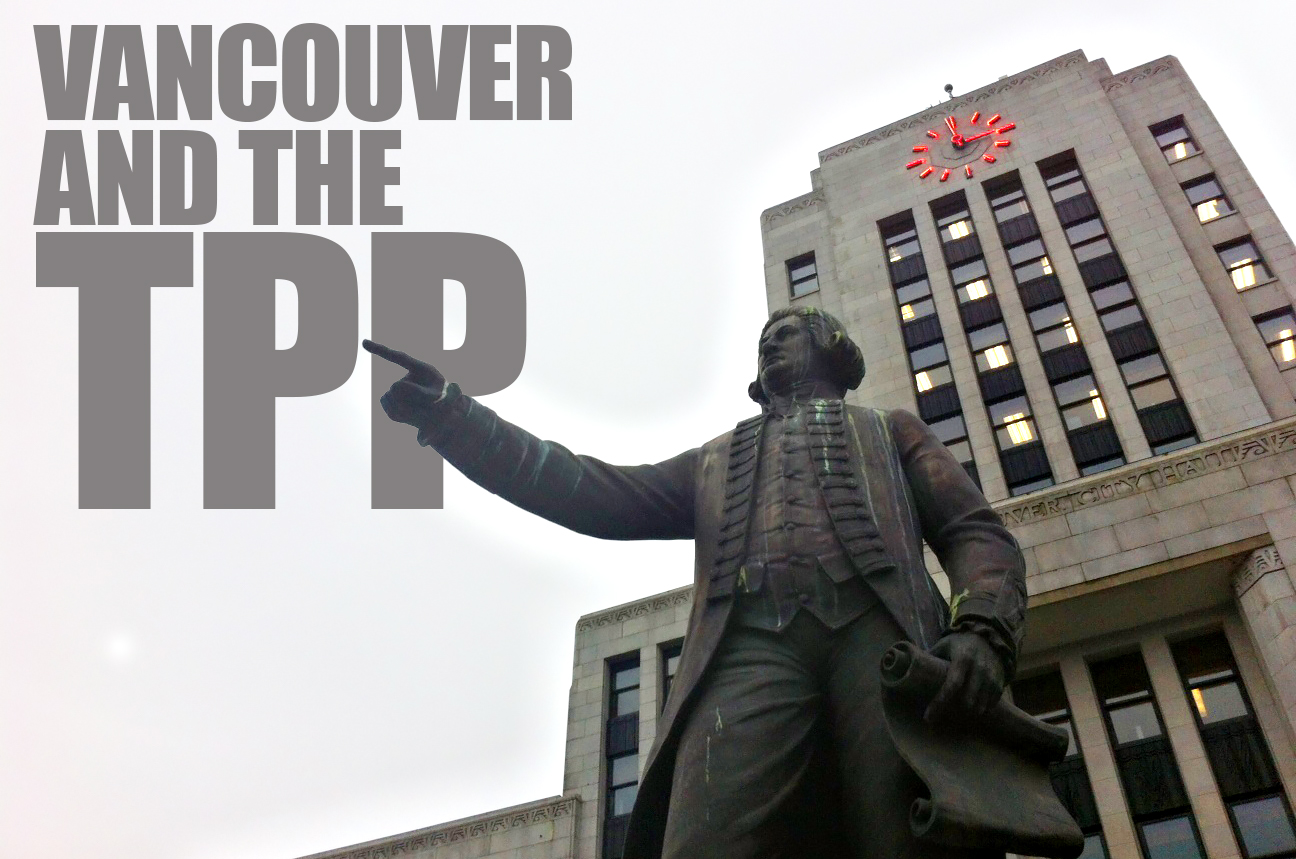
  • Vancouver and the TPP

    Vancouver and the TPP

    What might the Trans Pacific Partnership Trade Agreement mean here in the City of Vancouver? — with the notion of foreign investment already a hot-button issue in Vancouver real estate and unaffordability; what might the TPP and its extrajudicial Investor State Dispute Settlement process mean for local land use? What about the TransMountain pipeline and our aspiration to be the Greenest City. How about buy local programs? There is much we don’t know yet about the 6,000 page trade agreement released just three weeks ago — but already US cities like San Francisco, Seattle and New York have voiced their opposition to the deal. Should Vancouver follow their lead?

    [Today at Vancouver City Council, I spoke in support of Green councillor Adriane Carr’s motion “Opposition to the Trans Pacific Partnership Trade Agreement”. With unanimous cross-partisan support, the motion was referred to staff for study with instructions to report back before the item is ratified by the House of Commons. The following is a transcript of my presentation to council and staff]

    I’m here to speak in support of the motion to oppose the Trans Pacific Partnership Trade Agreement.

    My opposition to the TPP is not a blanket condemnation of the idea of trade agreements in general, and I recognize that the facilitation of trans Pacific trade through Port Metro Vancouver is significant economic engine for our City and region.  

    Further I want to acknowledge that the TPP may yield some larger benefits to environmental concerns if it leads to greenhouse gas and atmospheric pollution reductions particularly in developing nations like China, Indonesia, and Vietnam.

    HOWEVER

    I think there is much that we don’t know about the TPP, a global plan with potential significant local impact, impacts that may work against our own interests here in the City of Vancouver. Of course, I’m neither a lawyer nor an international trade expert — and I’m sure council and staff have reviewed the TPP and likely have their own concerns — but a few items I have flagged.

    Vancouver’s brand as Greenest city. 

    I attended a recent event where councillor [Andrea] Reimer described the notion of how the Kinder Morgan TransMountain pipeline expansion into Burrard inlet would not only undo our city’s greenhouse gas reductions in just a few days worth of exported product, but further, it would actually damage our brand value as “Greenest City” and the attendant worth that imparts as a place to visit and do business.

    We know categorically that the TPP will promote energy investment, and in particular in the Alberta oil sands. With Keystone XL and Northern Gateway effectively off the table — we are going to see enormous pressure to get Alberta diluted bitumen to Pacific tidewater, and quickly. Particularly as the United States are considering lifting their crude oil export ban and Australia’s growth as an oil shale energy exporter will mean a high stakes race to get to the Asian oil market.

    Of course, detailed in chapter 9 of the TPP : industry will be protected under “distinct, reasonable investment backed expectations.” and subjected to extrajudicial Investor State Dispute Settlement process. In the interest of strengthening our position in opposing the pipeline expansion into Burrard Inlet, we are compelled to oppose the TPP.

    Another issue of concern is Chapter 15, Government Procurement — wherein the idea of local procurement is effectively subjected to the trade deal and aforementioned investor dispute resolution process. 

    Local procurement is of course a significant factor in the Greenest City Action plan, local food security initiatives, and reducing our carbon footprint — not to mention its role in strengthening our local economy.

    Lastly, I’m extremely concerned about local land use. While there’s no consensus on the role of non-local and corporate investment in the Vancouver real estate market, I think all parties agree that there is a lack of data to make a conclusive study. We need that data, certainly as the TPP opens up our local market not only to increased investment — but subjects those transactions to the investor dispute resolution process. 

    This will likely tie our hands when it comes to the idea (supported by our mayor) of finessing our existing property transfer taxation system. TPP may make ideas like a speculation and/or luxury property tax legally untenable, and most certainly a non-local investor tax would be off the table. 

    Furthermore, how sure is the city that our system of Community Amenity Contributions* can withstand a legal challenge under the TPP? We know that voluntary CAC’s exist in something of a grey area, and have been subject to scrutiny and concern from the Provincial government. Considering the City’s reliance on CAC’s this seems very dangerous territory to me.

    And to that end I urge the city to exercise prudence and follow the example of other metropolitan areas is opposing the TPP, at the very least until a full comprehensive analysis of the risks and any mitigating considerations to protect the interests of Vancouverites.

    * [Community Amenity Contributions are a voluntary developer contribution toward public assets like parks and social housing as a condition of rezoning. CACs contributed about $350 million over the last four years and became the subject of Provincial Government review who singled the Vancouver model out as an unapproved method]